


#345: Smarter, Not Harder: How Small Businesses Can Actually Use AI
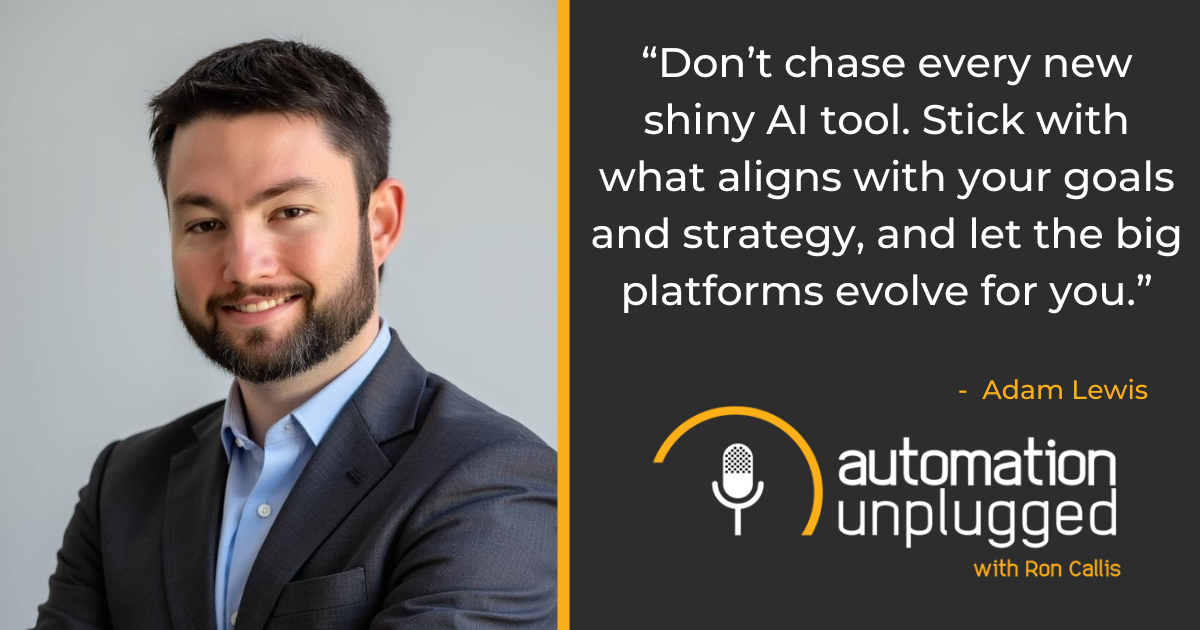
Join Adam Lewis, Executive Account Manager and Data Analytics Team Lead at One Firefly, as he chats with host Katharine Wheeler about how small businesses can harness AI to save time, streamline workflows, and make smarter decisions. With nearly six years
This week's episode of Automation Unplugged in our Marketing Experts segment, we’re joined by Adam Lewis, Executive Account Manager & Data Analytics Team Lead here at One Firefly.
Over his six years with the company, Adam has built a reputation for helping clients turn data into decisions — and he’s been leading the charge in testing how AI can save time, streamline workflows, and reveal real insights.
About this episode:
This episode is hosted by Kat Wheeler, and together she and Adam dive into:
- How to identify the AI tools that actually make a difference
- Simple ways to automate repetitive marketing and reporting tasks
- And why the future of business success is built on AI plus human collaboration
SEE ALSO: #344: Reflecting Innovation — Tony Blodgett on Seura's Mirror TV Evolution
Transcript
Kat:
Hi everyone, and welcome back to another episode of Automation Unplugged Marketing Experts. I'm your host, Katharine Wheeler, and today we're talking about something that's kind of on everyone's mind right now. AI, it's in your inbox, it's in your newsfeed. It's even in your family group chat, and sometimes even in your toaster if you bought like the fancy kind. Uh, but for small business owners, AI isn't just a buzzword. It's a real opportunity to make your days easier, faster, and a lot more efficient. If. You use it, right? So to help me make some sense of this, I'm joined by Adam Lewis, executive account manager and data analytics lead here at One Firefly. Adam has spent years helping businesses use data and automation to make smarter decisions, and he's been deep in the AI trenches lately, testing what actually works for small teams and what's just hype with subscription bets. So Adam, welcome to the show.
Adam:
Hey Kat, thanks for having me. It's, uh, great to finally be on the show. I've watched a lot of the episodes over the years and it's cool to hop on and, you know, talk about some stuff.
Kat:
A lot of the episodes, not all of the episodes.
Adam:
Majority of the episodes, you know? Okay. I can't watch all of them. Uh, maybe listen to more than I've watched, but, uh, yeah, majority of them I would say.
Kat:
I'll take it. All right. Well, before we get into the good stuff and what everybody's here to hear about ai, uh, let's let everybody know a little bit about you. So can you tell us a little bit about your background, how you got into data, data analytics, what you do, what Firefly, et cetera?
Adam:
Yeah, so I've been with one Firefly for over six years now. Um, really got in on the account manager side of everything and I worked my way through the ranks with that. And I've always really liked data and analytics. Any of my clients will tell you. That we dive deeper in data than probably they were ever wanted to. And that's just kind of how I operate. And I, you know, try to tell the story through data and everything like that. So it just kind of clicked really well for me. And I always like geeking out on spreadsheets and, you know, trying to find trends and things like that. So it's really just kind of been ingrained into me the whole time. Um, just coming up through that kind of lifestyle and just being in the industry we're in, just helping the. Businesses we are. Um, it really kind of helps paint the whole picture in my opinion, and just really gives them the data points and things they need to, you know, go back to, is it return on investment or am I hitting my goals or things like that. So, um, it's really getting tied into that. And then an opportunity opened up in one firefly, um, to dive in more of that. So now I head up that team. As well as, you know, managing some of our, um, you know, higher end accounts. Um, so I still am an account manager, but I do a lot of the, like I said, data analytics, um, on the side as well, I guess, uh, as you would say,
Kat:
I love it. Um. And it's kind of such a perfect mix of like human and analytical sides of our business, which is exactly kind of what we're gonna talk about today. So I wanted to start out with something that our AV integrators won't be familiar with. Uh, we're a big conference industry, but you guys have been heading to a new kind of conference for the last couple of years. Uh, so it's a mixture of marketing and ai. There's a conference for that. Uh, so can you tell us a little bit about it? It's kinda like Comic-Con for marketing geeks.
Adam:
Yeah, for sure. It's called Macon. Um, yeah, our team has been going to it for the last couple of years. I was able to join the event this past year, um, and really dive into a little bit more of the AI world. What's out there, what's possible, where the trends are coming from, how people are using it, how you should use it. What's, you know, noise, what's real. So I really dove into a lot of the behind the scenes stuff and learned a lot of cool things. It's only a couple days conference, so there's a lot of packed things in that, and you really kind of take with a grain of salt, all the things that are out there, um, because not everyone is, you know, they're in different parts of their journey, so you want make sure you're not, you know, getting too stuck into one thing or you've heard people talk about chat, GBT or Gemini or perplexity, but what's. Going on with a scene called Jasper or any of this other stuff. So there's so many different things out there that you, there's a lot of, there's a lot of noise and a lot of the big characters, like I mentioned, they try to simplify it, but there's still, um, you know, a lot going on behind the scenes.
Kat:
Any big takeaways from last year's event?
Adam:
Yeah. Um, you know, just as a, a company with one Firefly, like I feel like we've done a lot of innovation early on, um, to just stay ahead of the game and to stay ahead of the curve. So it felt really good to go to the event and not be like, oh, this is something totally new to me, or I've never heard this before, or things like that. 'cause there was a lot of people that I spoke, spoke to from small businesses There. That were like, we haven't done anything with ai. We don't even know what it is. We are just like curious about it. There were a lot of local companies that were doing that. Um, so it was cool to know like, oh yeah, we've done this or we've talked about that, or at least we're planning on doing something with this. So I think that was like one of the biggest takeaways for me. Um, and then there was, you know, some things about like automation and reporting and stuff that I, I really enjoyed and thought we could save some time with. Um, but there was also, um, there was some video AI that was pretty cool. Um. SOA V two came out end of last year or something like that, right around the time of Mayon, and we gotta demo some of the stuff there of what it could do and just where it's really come. And there was points where you couldn't really even te tell that it was AI generated. It had real people in it or we thought was real. It was based off real people, so that was pretty cool. But, you know, just the, the whole, the whole show, I could go on and on about, you know, what was interesting and what was not, and stuff. I, I don't really think there was a part of the show that I would say, Hey, this wasn't worth my time or worth coming. There was lots of cool things. So you don't really say that about many conferences that you go to, you go to family like, oh, I got one piece out of it. But this one was packed with two days full of, you know, stuff that was interesting to learn about.
Kat:
Fair. Okay. Cool. Well thank you for that. 'cause I, I'm jealous 'cause I didn't get to go. Yeah. Uh, so before we move into kind of like our, our deep dive into AI and how small businesses are using it, that, uh, that, that again isn't just noise as you said. Uh, we're gonna play a little game. Okay. Like a game. Uh, so here's how it works. I'm gonna read you a list of a couple of, uh, business tasks, if you will. Okay. And you're gonna tell me whether something, it's, something AI can help with or if it's be better handled by like a person. And so the game is called automate or Delegate. So automate, obviously if AI delegate, if like obviously a person. Okay.
Adam:
Okay, I got it. All right.
Kat:
You ready?
Adam:
Yeah.
Kat:
All right. Uh, schedule meetings across four people in three time zones. Automate or delegate.
Adam:
Automate. Yeah.
Kat:
For the girl who can't like do the math on time zones, like AI helped me a lot.
Adam:
No. Yeah. I, I did something earlier this morning where I messed up the time zone, you know, differential from where I'm at and I was like, why did I schedule this for when I can't do it? And I was like, oh, I one hour off. Because Arizona doesn't go with the standard of where they are. They just go with the year and stuff, so, totally understand. But yeah, totally automate that one.
Kat:
Okay, cool. Uh, summarizing meeting notes or transcripts, automate or delegate,
Adam:
automate,
Kat:
has it not just changed your life?
Adam:
Yeah, it, I mean, in a way I think it's changed my life and in a way I think it's made it realize how like important it's to have like a fathom or something like that in my meetings now, because I used to be like taking stuff on like notepads, writing stuff down. It isn't like that anymore. So if my fathom won't join the call, then it's like, oh my gosh, what do I do? How do I do this? How do I go back in time? It's like I go back to like, you know, stone and chisel type time. I feel before something like that. 'cause it does such a good job of just doing the transcripts or remembering things and it tells me what was important, how do the things that I didn't even remember. So yeah, definitely automate.
Kat:
Okay. Uh, letting AI pick your fantasy football line up.
Adam:
It depends on how diverse you are in your fantasy football stuff. Um, I think AI does a good job of like, like cookie cutter kind of answers and things like that. But if you're a diehard, you know, fantasy football goer, I would probably delegate that and keep it on your side.
Kat:
Fair. Uh, creating custom responses for an angry client.
Adam:
Um, I think both, I feel you could automate it, but with the, you know, keeping the human component on top to go back in and kind of fix it for certain client. So I think it could do most of the work there, but it's still getting there with the tone and the voice and things like that. So I don't think that it would be you. Do it automated, then send it right over without looking at it. So
Kat:
yeah, I, I totally agree. I think it's great for like ideation and like putting some of your, some thoughts together, some key points to hit with a client, but especially if they're angry, you don't want it to sound generic or like you use chat GPT to write it.
Adam:
Yeah. You don't want to do that. Um, but like you said, you could do most of it there and then make sure you go back in and edit it to, um, how it needs to be said. Okay.
Kat:
Uh, creating a packing checklist for your next trade show.
Adam:
Probably automate. 'cause it, as long as you tell it what you want and where you're going and things like that, weather's a big one. Um, making sure it knows what the weather is. So, um, but yeah, it should be able to do that to automate
Kat:
designing your next logo.
Adam:
I would say automated. There's some pretty cool things out there that you do. You, you disagree, but I think it could do a really good job and you may have to go in again and use the human aspect to fix it, but I think it gives you some cool ideas that you weren't thinking of.
Kat:
I, the thing that bothers me about AI and the reason that I say, um. Uh, delegated is because AI is not creative. It can't come up with anything it doesn't already know, or that it hasn't already been fed. And that human cre like creativity is something it will never be able to do. Uh, so while, yeah, you could get ideas, it's just copying somebody else's ideas or tweaking them, it's not, it's not that real spark of creativity, which I love. So I would say delegate it.
Adam:
Yeah. I could see that, I could see both sides. 'cause you could make someone else's idea better and, and expand upon it. You know, everyone else, like, think of cars like out there. Everything is the same thing inside, but you slap a different logo on the front, it makes it a Toyota or a Ford or whatnot. So it's kind of the, oh,
Kat:
did you see that new Jaguar 'cause good god.
Adam:
Yeah. So it, uh, I digress anyway,
Kat:
uh, okay, let's get back into it. Uh, analyzing sales data to find trends. Your favorite thing.
Adam:
Yeah, you definitely automate, saves a ton of time and it's gonna get you the same outcome that you have because in the end, data is only numbers and, you know, trend lines and things like that. And it finds 'em much faster and gives you much better insights of what you should do with the data that you're looking at. So yeah,
Kat:
love it. Uh, responding to customers dms on Instagram,
Adam:
I don't think you should automate that 'cause that would probably get kind of weird. So let's, uh, delegate that and keep your Instagram on your own.
Kat:
Uh, drafting follow up emails after a client call,
Adam:
I think you're fine to automate that with, again, just making sure to check and see if it went down your notes and things like that.
Kat:
Okay. Uh, tracking inventory or project timelines
Adam:
definitely automate. I.
Kat:
Saves a ton of time.
Adam:
Yeah. It takes out the human aspect of that. Like I keep going back to saying, Hey, make sure you do this. You can automate it, but have the human check it in the back end. That's kind of the, the trend is some of the answers you see I'm doing. But, um, I definitely think that one is take the human out of it because we do still make mistakes and we don't see the best way of doing that. So I think automating that process fully will help, um, you know, just time's sake,
Kat:
uh, setting pricing strategies for new services.
Adam:
You would have to get down the rabbit hole a lot with like custom GPTs and stuff like that to really understand the client and build a persona and stuff like that. So if the rip, I would say delegate, um, to keep it on a person because you're gonna have, like I said, that persona and everything, but if you could build out like a custom B-G-G-P-T or something like that, then I think you will eventually be able to automate again with just making sure it looks at the end, right. But right now, delegate.
Kat:
All right, last one. Generate talking points for a sales meeting.
Adam:
I think you could automate that. You could delegate it, you could do both. It depends on the, the depth of the meeting. Like if you're looking for general ideas of where to talk and where to speak to, I think it does a good idea of coming up with things you wouldn't have thought of or different. Things, but then I think you still need to bring your aspect in. So I know I've kind of copped out on a lot of these answers, but I think it goes back and forth because again, you said earlier the personal touch is where, what it really needs, but it does 95% of the work to get there. So as long as you can come on top of AI and give that human personal touch, I think using both a lot of these situations will work in the best case of of both worlds.
Kat:
Way to be wishy-washy, Adam? No. Um, you know, to that last point, talking points in a sales meeting, I'll tell you what I do. I take the recordings of meetings if I've had like different ones with the same client mm-hmm. And I put them all in and I ask it, you know, to kind of summarize where we've been and where we're trying to go and what our next steps are. And then I can take that as kind of like a jumping off point.
Adam:
Yeah. And that's kind of the what I said with like, you automate it and then you look, go back in and do it. So it's kind of like wishy-washy back and forth, whatever you wanna call it. I think that's kind of the world we live in right now with ai. It's, it's like mostly there. But there's still the human aspect. You need to make sure that it gets the best of both worlds.
Kat:
All right, and bonus route, purely for chaos. Would you let Chappy Chat, GPT, pick your Halloween costume?
Adam:
Sure. Why, why wouldn't I? Well
Kat:
now, well now we're going to, and you're gonna wear it on, uh, for Hall next Halloween.
Adam:
I mean, I, I'm fine. I am, I don't like, I, I'm the kind of person that like, you know, not get too tan or anything like that. But I used to do crazy things with my hair for, I used to coach swim team and we would do crazy like, um, on the championship meets. We would all like do things with our hair. Whether it was dye, different colors, or I've cut like the American flag in my hair. I've done the British flag in my hair. I've done Mohawk first, Mohawk, all that kind of stuff. So I'm not one to, you know, you know, go away from interesting ideas that something comes up with because I think it come up with something cool. Um, you know, it would probably combine a lot of different things and you look kind of ridiculous, but it's one night. So. Just got there.
Kat:
Challenge accepted. Adam, you've locked yourself in now,
Adam:
so I'm locked in.
Kat:
All right, well thank you for playing my game. Spoiler alert, you won. You didn't have any competitors today, so that was a little easy on you. Well
Adam:
next time we'll get like a
Kat:
panel and we'll make it harder.
Adam:
Yeah.
Kat:
Okay. Well, so this is where we kind of like jump off into our conversation 'cause I think we highlighted some of the biggest misconceptions about ai. 'cause it's not like an all or nothing thing. I called you wishy-washy. I was joking. But AI is amazing for collaboration, organizing data, like doing some admin tasks, things like that to give you a jumping off point. So let's, let's kind of unpack that a little bit. Where do you see small businesses getting the most value from AI right now?
Adam:
Yeah. I, I mean, I think honestly it's, it's with the boring stuff, not boring per se, but the, the minuscule tasks that just take a lot of time to do, like, we kind of touched base on really like maybe crafting emails or going through data or going through things that, you know. Really you wouldn't spend a lot of time on if you didn't need to. So it's those tasks that no one wants to do, but you have to do them for a business, I think is what most businesses would do. Now it goes down the rabbit hole with your understanding of AI gets a little more complex and you can do a lot more things, but. Day one, starting off, just keep it very simple. Automate the tasks that are taking a lot of your time that are repetitive, or you need to kind of go in and do the same thing over and over. I, I think those are the ones that most small businesses should kind of, you know, take off their plate first and then start to learn AI a little bit more to get a little more advanced with it.
Kat:
I love that because it's kind of like the micro wins that really matter and kind of like add up over time. So like summarizing notes and cleaning up spreadsheets and you know, streamlining internal communications. All of those little things that save you time and give you the ability to focus on the things that make you money or make you more efficient or whatever.
Adam:
Yeah, I mean that's definitely, you know, like the big one is just kind of say strategic with your goals, um, and what you're trying to get out of it. And don't just go out, out of like the nice new shiny AI tool that everyone's talking about, because there's plenty of things out there that will do one simple task or one simple thing. Like, you know, Chachi pt, the Geminis, the Perplexities, they usually. The next update of those adds, whatever the little, you know, shiny tool was in, into what you're used to doing. Um, because a lot of those companies, instead of innovating and they're, you know, getting ideas from themselves just going to buy out the, the person that came up with a really good idea. So that, we've seen that so many times and so many things over the last couple years with.
Kat:
All right, well let's, let's dive into this a little bit 'cause I think, I think you're gonna touch on my next point that I wanna break up, like kind of the trap of ai, which is that somebody starts testing it, they start getting a little more comfortable, and then they end up signing up for free five different tools and they're free trials that they had that are $20 a pop subscriptions, and then three months later they're paying tons of money and, and AI overload. So how do we avoid that trap?
Adam:
It's a good question. I think just overall is, like I said, not just touch the new shiny thing that comes out. Make sure that it makes sense for you to do and make sure it makes sense for you and some of your strategy and goals. Um, if we can just make sure we're, you know, doing and delegating the things that are need to be delegated and staying on that task. You can start diving into the, the cool, shiny things, but. Like I said, they're always coming out. They're always coming new ideas and the ones that I said earlier, new ideas get bought up by the big companies and they get integrated into the chat GPT, so chat GT one, it's way different than chat G five or 5.1 or whatever the number is at this point. So it's coming through so many different iterations that the things you're comfortable with doing, um, because they're all doing the same thing, like, you know, a, a chat, I was talking about custom GTS earlier or with chat gt, but Gemini does gems. They're the same thing. And that goes back to my analogy about, you know, going with Ford or Toyota or whatever, slapping a different, you know, logo on the front of it. So they're all kind of doing the same things. But if you kind of stick with the, you know, main three to five, like, you know, big ones out there, they're gonna get you most of the things done. And I wouldn't really worry about most of the other noise that's going on in the background because those ideas come and go and it may help you a 10% more than like the chat GPT or something like that would.
Kat:
I love that. That's such good advice. And I think, I think you're right. The best approach is kind of experiment slowly and focus on, you know, like the workflow and not confusing, busy with productive and all that kind of stuff that we say about other things. Also applies to AI and, you know, uh, PSA for everybody out there, uh, cancel your free trials right now. Yeah. Uh, so before we wrap up today and. Uh, you know, as we kind of dive down this AI rabbit hole, I wanna ask you the crystal ball que question. Mm-hmm. So, where do you see AI headed in the next couple of years for small business? Are we headed towards easier integration and smarter tools or just like more stuff?
Adam:
Yeah, I think there's always gonna be more stuff out there and more things to do. Like I said, there's always gonna be companies coming out and trying to do one simple thing like this is what they focus on, whether it's video, whether it's, you know, scheduling, whether it's data, whether it's all those things. And I think in the next couple of years where we're pushing to is. Really like stripping down the like task at hand or what your roles look like? I don't really seek, like, yeah, there's gonna be jobs that are lost and things like that, and that's the big scary time. The AI's gonna take my job, but there's already companies out there right now that are creating, like say they have 150 employees. And then they have 300 AI teammates. So they have a company of almost 500 people, but only 150 of them are actually, you know, real people. But their teammates there, the people are running. Those teammates, there's not really running independently. Some of them are getting more advanced to where they can run more independently and do scripted things. But mostly what I think is gonna happen is like, say. Like, my role as an account manager is still gonna be the same thing. I'm still gonna be talking to people and, you know, going over their campaigns and things like that. But maybe there's more minuse tasks like, you know, creating newsletters or doing, you know, custom copy and things like that that might get taken off of me, per se. It goes to my teammate to handle and then I'm overseeing what that teammate does, and then I send out the, you know, the polished version over to said client not saying that's what. Is happening or anything like that. But I foresee something like that and taking that away so I had more time to innovate, speak to my clients, get to the next level, and really, you know, dive in a little bit further than what I could because, you know, with a report. It could take me, you know, two hours to dissect the report, two more hours to put together a presentation for, you know, what it needs to look like, and then like another hour to polish up an email to a client of what that is. And AI could do that in seconds, um, kind of thing versus that. So that takes six hours or five hours, whatever I just said to me, going back into spending more time on the client's campaign itself and making it better. With that time, instead of like spending time doing, you know, those tasks. So I like the long story short. I think where we're going is those tasks are gonna go away. And we're going be there some more time on the things that actually matter. Things that are more important in the end. And you're gonna, you're gonna see AI teammates and people are gonna think it's scary that AI's taking over, but they still need people to manage what they're doing. It just is here to help us. Think of it as like your assistant or your buddy. Like you don't want to do all of your stuff. Like I'm sure there's things you don't wanna do, Kat out there and you want an assistant to do. Everyone wants an assistant. So think of it as your nice assistant that's gonna help you do your job better. And that's the way we need to look at it because it's, and Iran said this before, one Firefly said this before, but it's AI plus human is is the way to go. It's not all ai, it's not all human. And we need to be the best of both worlds.
Kat:
Yeah, it's good call. Um, I love what you just said about having, you know, a team of ai like. Staff members that you can program to do certain parts of your job. Because to my mind, I don't think of it as, as AI replacing humans. I think of how much more capacity you, Adam, would have to have more clients and to help more people if those like that minutia was taken off your plate. If you were kind of fed all of that data for you to analyze, look at, see the win, see the losses, meet with customers. 'cause you know the person aspect is best of it. You could do so much more. Exactly.
Adam:
Yeah. You just have more time. And at the end of the day, time is our worst enemy. You know, there's only so many hours in the day to do something, but if I can cut down. You know, 20%, 40% of my daily workload into something else and someone else is helping me with that. Then I have 20, 40, 60% of my day to spend time with clients and do more things that are innovating their goals and everything like that. So that's really what it is and that's what people need to think of. It's not taking your job, it's making your job easier in a way so you can innovate more in other aspects of your job.
Kat:
Okay, and Rando crazy question, Adam. What is the coolest or funnest thing that you've done with AI
Adam:
so far? I think just kind of going back to what I said with the data and reporting and stuff like that, like automating a report from scratch. Without doing anything, um, like myself, like I told it to go do something. It sent a report to my email. I checked the report and it was good to go. So I didn't have to spend those two to four to six hours doing the research on the report. And obviously I checked it to make sure it was accurate and everything like that, the first iteration and, um, things like that. But to me. Doing things like that. And there's also some cool stuff that came out, you know, probably in the last couple of months with um, Google Sheets and you're able to equals AI and just type in what you want and it comes up with the formula and stuff for you. So that's pretty cool if you haven't checked that one out.
Kat:
Oh my God.
Adam:
So if you're not a spreadsheet person, you don't know. No, I
Kat:
sum everything. I'm like, let me do the math equals sum.
Adam:
Yeah, you can literally go in there equals AI parentheses, type whatever you want. Like this is what I'm trying to do in parentheses and then it kicks out whatever your formula needs to be. Instead of you going in and like vlookup this to go into this or you know, concoction this, like all those formulas and things that people get all confused with. And it's like, it's a, this is what it's supposed to be. Why isn't it working? And it's like, it doesn't really tell you why it's not working. And even if you have a formula you thought is working, you can just go over the little thing in the corner and tell Gemini to fix it and it just fixes your formula for you. So
Kat:
now this is what I'm talking about. This is useful. This I actually need, um. You know what? I made it 90% of this call without saying it, but that's not actually artificial intelligence. I have a problem with the definition of ai. Adam and I have to make it everyone's problem.
Adam:
It's, I mean, yeah, it depends on what, how you look at it, but in the end, AI is just a computer. So it's a computer making you better.
Kat:
What it is. Okay. It's fine. Uh, okay. So I wanna thank you for coming on today and talking about this. And I wanna actually thank you a lot 'cause you've taught me something and now I can just equals AI and. My life will change for the better. But no, I think, I think this is an important conversation that we're having, not just in our industry but kind of, especially in our industry because we are a group of first adopters, uh, in technology and it, it makes us do crazy stupid things sometimes. And I love what you said about checking the work. 'cause AI hallucinates and does weird things and. But I also love what you said about how when you went to that conference, you were surprised at how many people hadn't done anything with it. And you gotta get on, you gotta get on board the train, you can't get left behind here.
Adam:
Yeah. I honestly think that's the biggest thing. If anyone takes anything out, I'm glad you took the thing out with equals ai. That's that. Definitely a good one. But if anyone else takes anything out of this, just making sure that. Even if you're a small business or whoever, a big business doesn't really matter who you are. If you're not embracing AI in some capacity in your organization, you're gonna start falling behind if you're already not behind. Like, it's not to a point now where everyone's like, oh my goodness, I need AI in my life. I need to do this. I need to automate this. It's kind of, but it's gonna get that way pretty soon. Um, as you can already see some of the larger companies out there. Most of them are ai. There was, you know, articles end of last year kind of thing talking about, you know, that Amazon was gonna be 600,000 people less. Like hired in the, by 2030 than they thought they were going to be because of the power of ai. And that's just, you know, here and it's here to stay. It's not going anywhere, unfortunately, for you Kat, and your, you know, back and forth AI conversations. But, um, yeah, I think that's the biggest thing to take out is just make sure that you guys are, um, going out there and experimenting with things, but just kind of like I said, staying with the, the top five. Really, they'll get it eventually. You don't need to go into all these different subscriptions and things like that. So.
Kat:
No, I, my point that I'm trying to make, I, I love that. I think there's a lot of good takeaways for our, for our people from this, especially just getting involved in some capacity. But my, my thing about AI is that I think we need to, especially for our industry and especially for our customers, help them define what it is they're actually doing. Because artificial intelligence is A, not accurate, and B, extremely broad. Mm-hmm. To just say that for everything that we're doing, you know. Creating automations in your workflow and having, you know, chat GPT talk to five different systems that you work with is great automation, but it's not the same thing as using it for ideation or for creating a PowerPoint. Like there's different things you can do with it that are different kinds of concepts, and I think we should talk about 'em appropriately.
Adam:
No, yeah, I totally agree you, it's not one box, it's not one size fits all. It's not, it's whatever you want it for, but I, I guarantee you there's something out there that is one. What you want it to be. So, like I said, I know I'm really stuck in the data and reporting and the automation workflows and all that kind of stuff really helps me. But yeah, I mean it's everything out there can be. Changed in some way and altered and helped. And I think if we just keep that in mind that it's a helper, it's an assistant, it's a teammate, it's not taking over your jobs, it's not gonna do that. And like I said, yes, it will take over some things out there, but you just have to adapt and change whatever you think your workflow is or whatever you think your job title is, and kind of alter that to the new world. And that's what you do now.
Kat:
All right. Well, I appreciate it, Adam. 'cause I think, I think this is a conversation we're gonna have to keep having, uh, over the next few months and years as things keep changing so quickly. So I appreciate you kind of giving everybody a little bit of a headstart on what. Where it's going, if we can even say that. Um, and thanks for being on Automation Unplugged marketing experts. We will have you back to talk about data and we will also be following up on what Chad GPT told you to be for Halloween. So both of those things will be happening. So if you like today's episode, uh, share it with Phil, a small business owner who's still wondering about ai, like, subscribe and do all the things, and we will see you next time on Automation Unplugged Marketing Experts.
Ron Callis is the CEO of One Firefly, LLC, a digital marketing agency based out of South Florida and creator of Automation Unplugged. Founded in 2007, One Firefly has quickly became the leading marketing firm specializing in the integrated technology and security space. The One Firefly team work hard to create innovative solutions to help Integrators boost their online presence, such as the elite website solution, Mercury Pro.
Resources and links from the interview: