


#348: Scott Smith on Scaling Your Business through Lighting Partnerships
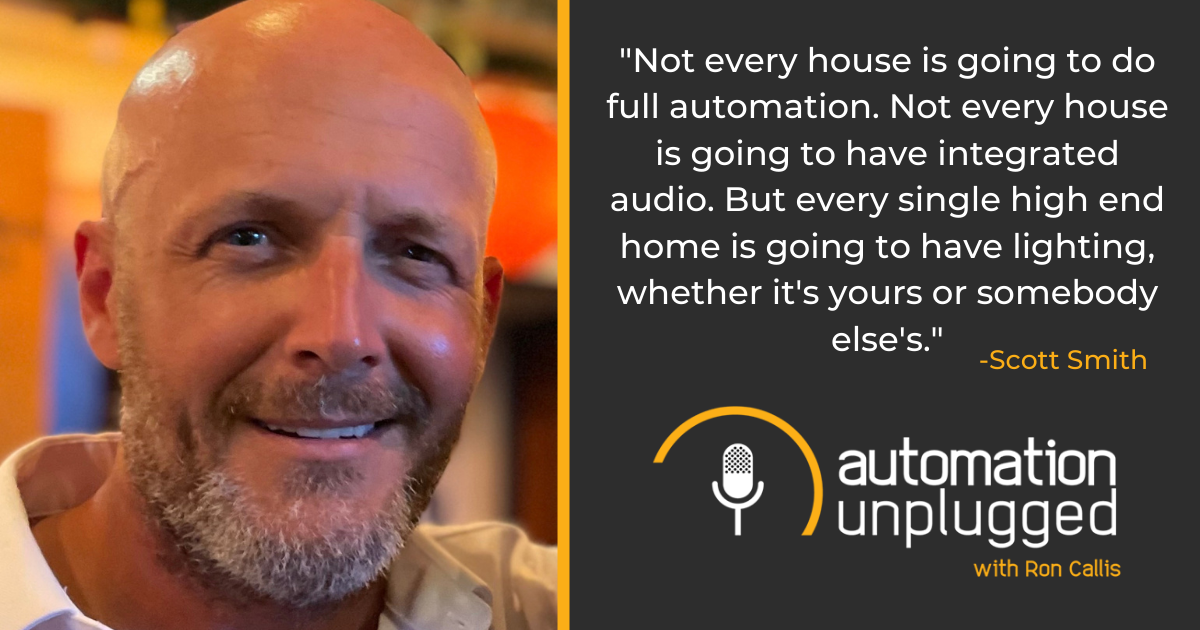
For Automation Unplugged #348, join Ron Callis and Scott Smith, founder of Arche Lighting Group, as they discuss why lighting is the fastest-growing vertical for integrators.
This week's episode of Automation Unplugged features Scott Smith, founder of Arche Lighting Group, based in Roswell, Georgia. Driven by a passion for lighting and its ability to transform the atmosphere of a space, Scott founded Arche Lighting Group to serve integrators, architects, interior designers, builders, and select homeowners throughout the United States.
Arche Lighting provides a complete turnkey solution—from consultation and design to documentation, specification, and project management—skillfully crafting the atmosphere of spaces that feel comfortable and inviting.
About this episode:
In this episode, Scott and Ron discuss:
- The evolution of his career from AV integration business owner, to 18 year career with Crestron and even a stint in the NASCAR sponsorship world all preparing Scott to build and lead his high-end lighting design studio
- Why lighting is a critical, high-growth vertical for integrators
- The realities of project management in the lighting space and why on-site collaboration is the secret to moving from "lucky" to consistently "perfect" results
SEE ALSO: #347: Owning Your Luxury Market — Strategies for Winning More High-Value Projects
Transcript
Ron:
Hello, hello there. Ron Callis here with another episode of Automation Unplugged. Automation Unplugged, as always, is brought to you by One Firefly. You could call that my day job. But I am very excited to be here with all of you. I've got a very longtime friend, industry peer as our guest today. Without further ado, I'd love to let you guys know who's going to be on here for a fun chat about all things lighting. And that is my buddy Scott Smith. He's the founder at Arc Lighting Group and he's coming to us out of Roswell, Georgia, just outside of Atlanta. Let's go ahead and bring in Scott. Let's see how he's doing and let's get this party started. Scott, how are you, sir?
Scott:
Hey, Ron. Good to see you. How are you, my friend?
Ron:
I'm good, man. I'm good. It was awesome to run into you. I knew you and I were gonna record, then you and I got to see each other face to face just recently at the Lightapalooza event.
Scott:
Yeah, was Yeah.
Ron:
How was that show for
Scott:
You know, this was my first time going. I usually go to Leducation and some other lighting shows, but this was my first time at Lotte Palooza and I really enjoyed it. And I think there was, a lot of good offerings there for education for people and things like that. So I really enjoyed it. It was great. And the fact that it's in Austin, you can't really beat that. That's one of my favorite cities.
Ron:
food, great music, great It really is a great town, really is. So Scott, tell everyone kind of, first of all, where are you coming from? Had mentioned just as I was getting you announced you're out in Roswell. Is that a suburb there of Atlanta?
Scott:
Yeah, it's a suburb. We're about, I'd say about twenty minutes from Atlanta, from proper part of Atlanta. Suburb, but nice and quiet. We still have the advantages of where we need to get to the city, but enjoyed it where it's a little bit quieter out where I am. So yeah, and close enough to the airport to get anywhere in the country we need to go. So yeah, we're right outside the city suburbs.
Ron:
Awesome. And Arc Lighting Group, tell us about the business.
Scott:
Yeah. So basically what we do, we kind of do all things, lighting from design, documentation, specification, project management, and all that that entails from meeting with interior designers, contractors, architects, all of that. So we are kind of a turnkey solution. We can do procurement of fixtures on some of our projects, but a lot of AV integrators that we work with specifically, we usually do the design portion. We help with project management specification, and then they procure the fixtures, but that's what we do.
Ron:
What percentage of your work is residential versus commercial or other?
Scott:
Yeah, I would say now, I would say about ninety percent of our business is high end residential, specifically high end residential. And about ten percent is other projects such as hotels, mixed use, but the majority of it is ultra high end residential.
Ron:
Okay. And then, again, just trying to help our audience quickly understand the kind of the landscape of your business. How much of your work are you doing in partnership with integrators? Maybe an integrator had a relationship with a client and they're bringing you in versus you're doing direct work with, you know, your network that they're bringing you in directly to the client.
Scott:
I would say it's about, well, AV integrator portion is growing. I would say that as of about a year ago, it was about twenty five percent to thirty percent of our business. Now it's at fifty percent of our business and growing. Most of the AV integrators that come in and bring us into assist or to help with them, they end up reusing us and then the word-of-mouth through a rep or everything else. So it's been a lot of repeat business with AV integrators. So I would say the category is growing, but it's probably about fifty percent right now.
Ron:
What are typical projects like? These, I'll just leave that open ended on the residential side specifically. What's typical maybe size of the residence or the project and what's the timeframe you're typically involved in a project?
Scott:
That's a very fair question and I'm gonna answer it as closely as I can.
Ron:
Do your best. That's all we ever ask you.
Scott:
Do my best because the first answer is no two projects are the same. Nothing is unique. The challenges are always different. But I would say, on the, I mean, we've done, like right now I'm doing a project in New York City that's two thousand five hundred square foot apartment. But then I've also got another project that is in South Dakota that is thirty five thousand square feet. So I would say the average of the home we work in is the ten thousand to fifteen thousand square feet. That's what gets brought to us the more average. Again, we work in projects as small as two thousand five hundred square feet all the way up to fifty thousand, sixty thousand square feet we work on.
Ron:
What are the typical dollar values of these projects? Maybe that's another way, another lens to look at it.
Scott:
Yeah, the best way to answer that I think is there are, it really depends on who you're working with as opposed to who the client's working with. If I'm working, if it is the, and this goes, when I say we, I'm taking for instance, when we have an AV integrator that has brought us in and we're their partner going into it as far as the design side. I would say if we're working directly with a builder, the dollar is less, project scope, right? If you're working with an interior designer or a homeowner, it's high. But I would say the average, as far as we're talking about fixture dollar wise, is that the question?
Ron:
You could go there. I was just, I was thinking big picture, what's the dollar value of the property. But if
Scott:
you want to translate that, dollar value of the property, most of the dollar values of the property will start in the three million, but on average we're at five to ten million.
Ron:
Five to ten million.
Scott:
Okay. And
Ron:
then fixture or lighting design and fixture services that could be what's that spectrum? Is it tens of thousands to hundreds of thousands or is it in
Scott:
it's a really good answer because we've a really good question because, it's kind of like, you know, what does a car cost? Well, do we need a Ferrari? Do we need four wheel drive? Every project's different, I would say on average, design we charge per square foot based on the scope of that project, but I'd say, our projects typically run with fixtures and everything that the integrator would sell anywhere from fifty thousand dollars to half a million dollars. I mean, it's a pretty big range. It's so dependent on the project and what products we need to get the final result that we want. It really varies by project, but in that range, which is a big range.
Ron:
Okay, understood. I'm going to dive into, I have a lot of questions I've prepped in terms of both the relationship that a lighting designer and a consultant can have with an integrator and just general lighting industry questions. It's such an emerging category, a fast growing category for industry. Lighting's been around for one hundred years, but in terms of our channel and I'm being specific to the technology contractor designing, specifying, and servicing, you know, it feels like that's really been emerging over the last five to eight years or so. From my vantage, seems to be one of the faster growing categories, maybe only seconded by video walls or something like that. That also is a pretty hot emerging category. So I'm letting our audience know I've got a of juicy bits for you and I'm excited to learn from you and gain from your wisdom and experience. But before we go there, can you give us an idea of your background? I know you and I have known each other for a long time.
Scott:
Yeah, so actually, well, like a lot of people, it's funny. I started off many moons ago, you and I did. I think you and I probably rode a horse and buggy to work when we first met, yeah, I started off years ago in the AV integration business. I had my own AV integration business, which I sold. And then once I sold it, I went to go work for manufacturers and I worked for Crestron for eighteen years. So very long stint there, cut my teeth there. And then after that, I kind of left the integration business and I was looking for something new, something that I really enjoy doing that I was passionate about doing. And I actually had a, before I got to lighting though, ironically, as I was kind of figuring out what I wanted to do, I actually worked in NASCAR for a little bit. I was an agent in NASCAR selling sponsorships for a couple of big names. Worked for them. You probably didn't know that, but I did
Ron:
a I to hear more about What exactly did that, how did you land in NASCAR?
Scott:
Well, I just, I knew a guy who knew a guy and they had a couple of big names and those stickers on those cars are not cheap and finding the people to do those things are not cheap. So I was kind of like a little, I worked as a little, let's say Jerry Maguire of NASCAR where I was working and selling sponsorship.
Ron:
What does it cost to put a sticker on a NASCAR? Like what is a little tiny sticker gonna cost and what's a big, front of hood sticker gonna cost?
Scott:
Well, first thing is number of races. Number two is going to be the driver. If you want Kyle Busch, you're gonna pay a whole lot more for the front of his. It depends on the size of the sticker, depends on the number of races, but I can tell you that it depends on the race. But let's say
Ron:
Oh, does it change per race?
Scott:
It can. There's a lot of variables, but I can tell you this, if you want to be what's called the primary sponsor and you want to be on the hood of every single race for that particular driver, depending on the driver And depending on whether you're at full NASCAR level or truck level, depending on where you're at. I mean, it could run as much as three hundred thousand to four hundred thousand dollars a race for a main one. Then, but that's a main responsibility. Look, you can be on, it depends on the driver, but I know drivers
Ron:
that What the one listening wants to be a little sticker on one race, on a brand new driver that's eighteen years I'll
Scott:
tell you what I would do, if it was me, if someone wanted to do that, I would put them on a lesser known driver. Okay. And one of the, in the smaller division of NASCAR and you could probably get, then you're talking about one, maybe two, dollars four thousand to be on the hood, right? It all depends on, it's all eyeballs and who's important. And not only that, it's not always the winner that's gonna be the most expensive. Sometimes it's the guy who's the most excited, whether that be, he doesn't win everything, but he's always on TV because he's crashing into somebody or he's picking a fight or whatever else. That's all those things kind of come together to decide what the value is, how many eyeballs you're gonna get into it.
Ron:
That's fun. And then just going all the way back to your running an integration business, what market were you in when you were doing that?
Scott:
High end residential and some commercial. Back when I had
Ron:
Geographically, where were you in the country?
Scott:
Oh, I'm sorry, Southeast. I'm based out of Atlanta and most of our projects were in the Southeast. We did a couple in New York and California, but most of the integration business was based here in the Southeast.
Ron:
Okay. And that business sold? Yes. Sold? Like another
Scott:
actually, had a partner in the business and I sold him my stake into it. I just, he made me a good offer. We're both doing well. And it was one of those things where I wanted to, we just wanted different directions. I wanted to grow a certain way and he wanted to go another way. And it was very amicable and good. It's just we're in different pages. So, we thought we'd sell. I said, well, look, I'll sell out to you and then I'll go on to the next thing. And we did. And he successful for a lot of years after that.
Ron:
You spent eighteen years with Crestron. In those eighteen years, you learn a lot about the inner workings of integration businesses. And you learn what works, what doesn't work. You learn, you know, people that succeed and thrive and those that don't. Well, just out of curiosity, what are your perceptions around some of the people that just year after year figure it out and get it done and they grow their business they run a great business. What are some of their qualities?
Scott:
I can tell you if I'm being completely frank and honest, I did. What you just said was very profound that the ones that had businesses for years and years and grew and grew, and they all had a couple of the exact same qualities. Number one, adapting and adapting to the market. I'll never forget this. This is a great example, but right when I started my integration business, this is how long ago it was, back then people really, it was all about home theater. And by home theater, I meant the three gun projectors, and that's how old that you had to dial in. And this
Ron:
is a Runco CRT overhead.
Scott:
Oh yeah, Runco CRTs and all of that. And we're building out the room and still people still do that today. But back then that was what you, I mean, that was your bread and butter, right? Yeah. And it was great because if you wanted to Runco CRT back in those days, that's a very expensive projector. And then there was going to be maintenance where you had to line up the guns every summer years. So it was great. However, I'll never forget this, that was my business and I walked into another integrator's office. He invited me by, we were friends and I walked in and all of a sudden the rep walks in from Sharp of all places and had a DLP projector. It was the very first DLP projector I had seen. And it was a fifth of the cost, no maintenance, aim point and shoot, focus in, you're done. And the first thing that came to my mind was, okay, well this is over, this big CRT, this is the beginning. So you have to see the writing on the wall. Well, and then also, you know, so the rooms became less expensive as an effect. You can still do super high end ones, but there were less expensive options to get a similar result. Okay.
Ron:
You could get a nice room for seventy five grand. A quarter million or half million wasn't necessarily required.
Scott:
Correct. There's still
Ron:
a big difference or gap between a quarter million or half a million dollar room, you can get a respectable room for seventy five grand.
Scott:
So that being, and also, at that time, the theater room that looked like a movie theater and all that, people at that time started transitioning more to like media rooms. So we didn't have the seating and all that stuff. Again, it was still there, but it wasn't the whole market anymore. So what I'm saying is like what I did and what I noticed the most successful ones did is they said, okay, what's the next thing? And they got into automation, right? And automation and lighting control. And before maybe they, all they were offering with lighting controls is Lutron graphic eyes to go in the theater. And the ones that said, I need to adapt to the times, right? Went on to be very successful and they've, to this day, I mean, some of these integrators I still know to this day and their business from back then to now has completely changed. They were a big home theater place and now they're truly are an integrator and they're integrating shading and lighting control and all of this stuff. So they adapted, but I would see the other people, some other people that just in my experience said, no, no, we're a theater company. That's what we don't want to pick up automation. We don't want to do shades. We don't want to do all that. They're all gone. Again, they said, we're just going to stay in that niche, but I think that's the biggest thing is adapting to the times and accepting that things aren't the same. You've got to be able to adapt and get better at it. And you got to, what does the market call you? What is the need you're servicing? And the ones that I saw that were most successful were the ones that were looking to, well, what else do we need to be offering? What works? What is kind of dying out? I mean, think about it, if it was at the same time when I was there, if people were saying like, well, we're really focused on DVD being the source of video. Well, that's not reality anymore. No one really has that. I mean, you can have a kaleidoscope or something like that, but you got to adapt. So it's being able to adapt, adapt quickly and efficiently and to keep going. That is a hundred percent, I will tell you every successful AV integrator I saw, that is the number one thing that I saw them do.
Ron:
Out of curiosity, why do so few business operators fail at adapting?
Scott:
This is going to be a controversial statement, I was just saying Controversial
Ron:
podcast, that's what we're known for.
Scott:
Oh, think it's because, well, let me say this. We all love what we do, right? And we absolutely, I mean, we enjoy it or we wouldn't do it. Most people this is because we're interested in it. I think sometime in the AV integration, you can get to a point where you're becoming almost a fan of what you do versus the business side of what you do. I'll give you a great story. I think this taught me so much. This changed when I had my AV integration business overnight. And I remember this was back when automation was kind of new and back then there was FAST. If you remember FAST, it was AMX had a division called FAST. Right? Late
Ron:
nineties, right? Ninety eight.
Scott:
Late nineties. So I remember I had a partner in the business and he was a brilliant guy, brilliant guy. But I wanted my goal for every project was I wanted to get in, make everybody happy, make it work simply, easily, and then be happy. And if they do another house, we'll come back again. My partner though wanted to make things really cool for what he thought was cool. Okay. So when we had, we did this guy's house and he had a, we did his house in Mississippi. Then he bought a second house in Florida and it was in a high rise and he wanted, just back then we put in fast and Lutron lighting control. And I wanted to make it efficient, work like his house, did the other place, simple. Well, partner was a real fan of what he could do. Sometimes what you can do and what you should do and what's practical are two different things. So he said, Hey, listen, I got an idea. He said, I want to make it. So every time he opens the door to the condo, motion sensor goes off, turns the lights to a certain setting and then turns the music on automatically to a certain music channel. I said, well, I said, let me tell you what I would vote against that. Number one, nobody lives their life the exact same every single day. You have some things you do, but maybe he didn't want to come in every time the music come on. And he of course said, well, there'll be an override, whatever. And I said, also add something else that's going to break. And we're gonna get a service call because it's at that level of automation. That is correct. So the end of the story is I get a call from the homeowner who called me and he was furious and I could hear very loud noise in the background. Well, what had happened is back in those days, remember DirecTV had the music channels, right? Well, my partner had said it so the music channel would go directly to the jazz channel. Okay. Well, unfortunately this was at the time when DIRECTV was constantly changing their So let's just say that it switched to another channel and he had what was called a hot card. So he had every channel on DIRECTV. The channel that it switched to was not the channel that you would have in the background. Okay? And further, he was with the former Miss Mississippi as a date and brought her down. He opens his door, all of a sudden the new audio comes on and this was in the days of Fast when it first came out. So he walked over to turn it over and it froze. So he called me and I'm going, what is going on? My point being is my partner in that was being a fan. He wanted to do something, right? He wanted to do something cool. Well, that cool translated into a disaster. Whereas he would have been really happy to have one button on the wall to turn on music, one to turn off, something simple like that. So that was a long answer to your question of what do you think it is? I think sometimes when we start getting into fan and trying to be cool or do something, I hate to say too creative that we end up getting ourselves into problems. The ROI on doing some of that stuff is bad for not only you, but for the client as well.
Ron:
I have to know and the audience has to know, were you able to salvage that relationship?
Scott:
We didn't do another project with him. Let's just say that. Now, we had done a lot of, we'd done his main house, we'd done that house and we'd done a commercial project for After that, well, it took away our credibility because he had trusted us all before, but then we put in this product that, and at the time, not to **** on them, but it was new and it had some issues and yeah, it wasn't good. It's a great story, story books, and a good lesson. Then after When
Ron:
you to work for Crestron and you were out on the road, that became part of, I would assume some of your material for talking about maybe the benefits at that time Crestron over the competition.
Scott:
Yeah. Well, it did become some material on that. Obviously programming is key.
Ron:
Right. Programming is still the human component, right? That the human decided to make it overly complicated. That's the human issue. All right, well, let's fast forward, Scott. Talk to me. How did you, speaking of changing and adapting, how did you adapt into entering into this lighting phase of your career?
Scott:
Yeah. So, even though I came from integration background, transition to lighting wasn't because of that. Really, I had someone that had been talking to me. Mean, I'd always wanna do something artistic and creative. And I'm one of those people that if I am interested in something that I will hyper focus and it will take up all of my day, all of my night, I'll read every book, I'll do every type of experience to learn it. And I had someone that told me a little bit, they were doing some lighting and then I had a really great friend of mine who's been a lighting designer for about thirty years. And I got with him and he basically was kind of my Yoda and my mentor and actually did some, know, has done some work for us as well. And I just became very, very passionate about it and just really started, I just found that I naturally just loved it. I enjoyed making the end result. It was very creative and artistic. I enjoyed following and reading books from other people. And then I got so much experience doing it that I learned the pitfalls of it. So really I just got obsessed. I just really just enjoyed it. And you know, to this day we still get other lighting design firms that will call or architects that call to ask our recommendation on products and things of that nature. And We just get so entrenched in it.
Ron:
Love it. For integrators watching or listening that today, we're recording this at the end of Q1 twenty twenty six. Yes. This will actually air pretty close to the time you and I are sitting here chatting within a few weeks. There are integrators that are still at the very beginning of their lighting journey. There are integrators that are still in a watch and observe mode. There's a small minority that are, you know, both feed in and they're off to the races. So I guess from your perspective, what is talking to the integrator? Why should this be a category they explore?
Scott:
Well, first of all, I can give you a really, direct answer that why is this a category that they should explore? And that is not every house is going to do full automation. Not every house is going to do a giant LED wall. Not every house is gonna have integrated audio, but every single high end home is going to have lighting, whether it's yours or somebody else's. And I think that there's not a shortage of people that value it. And not only in one vertical, but a really good builder will value what you help him out with, interior designer and the homeowner. And it's an offering that, you know, again, we all love automation and integration and it's amazing. And it's such a cool part to have in your home, but there are some people that it's not going to matter to them, even though it may be it should, but they will all value lighting in some way, form or fashion. So I think it's a good offering to offer any of your clients. If you're working with builders, homeowners, interior designers, whoever it may be, they may not be interested in the integration, traditional integration side always, but it's another vertical to get into them with lighting. And it's continuing to grow. Mean, obviously, you've got Lightapalooza that popped up. I mean, that's a whole show dedicated to the integration business and lighting. And I can tell you one of my best friends who owns trade shows all over the country and they actually bought CEDIA a few years ago and they do not, there's no trade show that anybody opens up if there's not a high demand for that category. So it's a growing category, it's a profitable category and it adds a vertical to your business that can still get you in the door when maybe integration does not.
Ron:
So with all that foundation setting, what's the reason to partner with a lighting designer versus going at it alone? Say going at it alone, meaning learning those skills, taking people on your team to learn those skills, or even hiring someone and putting them on your payroll? Like what juxtapose those two options and maybe there's more options than
Scott:
that. Yeah, so here's my take. Well, I had, again, I had a real good friend of one of my closest friends also, his name is Chip Salisbury and he works for Lutron. But when I first started the business and I was pretty gung ho and just all full steam ahead, you know, and I'm a pretty positive guy. So I always think everything's gonna work out perfectly until it doesn't and then I'll figure it out. Well, he said to me a very good quote. He goes, okay, well, just remember, you don't know what you don't know yet. And I said, and that came to be very much the truth. So if someone's looking to get into adding lighting design and integration into their firm, what I've found number one is what's their goal? And their goal typically is, Hey, wanna sell fixtures. I wanna sell fixtures. That's really why I'm doing this. Now, lighting is just like any other discipline, right? Like automation or integration. You'll find, I I think every integrator at one time has probably done a quote and then the electrician says, Oh, well, I can do this. It's like, integration is one of those disciplines where you can't just take a class at CEDIA and then you're ready to go. That's what makes integrators so talented and knowledgeable is because they've had experience. They know a vendor can train them on this, but reality might be different. They have a lot of skills and talent just from knowledge. So getting into lighting is the same thing. You don't know what you don't know yet. And yes, there's great education like at places like Lightapalooza, they've got a great class. Peter Ramella teaches a great class there. But again, just like integration, you're not going to go to CEDIA and know everything. The same thing with lighting. You're going to get that education through the field. You're going to learn just the little mistakes that come up. So I think it's valuable to, if you want to get into lighting to contract and someone who's already been doing this for a long time, knows what you don't know yet and can't facilitate it. And also, a lot of times it's the integrators I work with will have us just contract with the home, we can do it either way, but they'll have us contract with the homeowner for the design. And then we hand over the specifications to them. They get the sale. They don't have to worry about all the stuff, meeting with the interior designer, meeting with the contractor. They can be involved as much as they want, but a lot of them turning it over to us. So number one, you'll have somebody who's experienced and knows what you don't know yet, which can be very expensive to find out in the field. I can't tell you, I'll give you a prime example. I had an integrator who we work with all the time now, and he calls me up and he goes, Hey, I got this project. He goes, we've already designed it out, but I just want you to look at it and tell me if this is going to work. And I said, okay. And the lights were kind of laid out in the grid. But as I looked at it, I said, what fixtures are you using? He said, okay, well, we're using the CSL ECOs. I said, okay, that sounds good. I said, how thick are your ceilings? And he said, what do you mean? I said, well, typically in a residence, you're gonna have half inch ceilings, in a garage, you're gonna have five eights, but unless you're in a high rise, most people are going to half inch nowadays. He goes, well, I don't know. I said, well, you need to find out because those fixtures that you spec are all have a minimum of five eights in the ceiling. He said, no, I don't think so. I said, double check the spec sheet. And he went and found that out and he was about to place an order for about sixty thousand dollars But that was just us knowing those little things there. And another example, I had a guy called me up and he had some, was putting some DMF fixtures in which DMF is great product, but he had them in a ceiling and it was a pitch ceiling. And he said, Oh, I'm gonna have the adjustable ones here. I said, What's the pitch on that ceiling? And he said, I don't know. I said, Okay, well make sure it's not a ten, twelve pitch because you're going to need forty five degrees and these DMS only do thirty five degrees. So these little things, just knowing a lot. So now both of these people I told you about now they just turn it all over to us and it makes them look good just because we've had the experience. Our documentation is I'm very, very proud of our documentation. So they can turn over a professional package. They've got they've got a professional lighting design service that can provide them everything and help make them look good and make them easier and make them get to their real goal, which is to be able to procure and sell fixtures. They can just put a good team behind them.
Ron:
What I lightly know is true, but I know you deeply know is true. So I'm wondering if you could maybe educate us all. What I believe is true that I've heard anecdotally is that the project management of a lighting project is significantly more complicated, more intricate, more involved. There can be a lot more pain than maybe what an integrator is used to with the normal audio video installations or automation installations. What's different about the project management of a lighting project versus maybe what our audience is used to?
Scott:
Okay. Well, first of all, you know, all credit due to an integrator, because I think it's a good example to explain it before we get started, just like an integrator or anybody think was easy to do home automation or lighting control in house, all I do is buy some speakers, throw them in the ceiling, I'll buy a sonos, I'll just put it in, I wanna make a bunch of money or whatever and everything's great, but that's not reality. There's gonna be just like there's intricacies in wiring that and budget and this, the same translates into lighting, but in a completely different vertical and with a new host of problems. So again, I'll give I'll give another prime example. I mean, typically, when you go into a house, we lay out lighting on a plan. You have to pay attention to things like elevations. You have to pay attention to what the cabinets look like. You have to pay attention to, when you're picking out a color temperature for a house, or if you're doing warm denim, you need to know what colors, of the furnishings are going to be, the cabinets are going to be, that's all relative to that. And in order to do that, you're working with the interior designer. Well, the interior designer is gonna change things along the way. I mean, it's just gonna happen. So, and also, cabinetry where stuff is moving, that's gonna affect the lights. The arc that they originally was going to be a eighteen by twenty five inches piece is now become a thirty six by twenty four. And that changes the lighting that you did. So keeping up with all that is one area, but also, put, I always say this, if you've got a lighting designer that does everything remotely, it is not gonna turn out well. And I will tell you why, because what's on paper versus what the reality of the build is, is completely different. There's always going to be minute differences. You don't, if I say I want to put a light dead center in this room or by a wall, Well, if I don't have a framing plan, which even high end residents don't always have that, that light may not fit there. Okay. So the simplicity of, hey, give us a RCP and we'll look at it and we're going to design out the lot of used hand that you put it in. That's never the way that it goes. So yes.
Ron:
You're saying you're destined to fail if you don't have on-site visits happening throughout all phases of construction to account for and collect what are the realities of the construction job site and or the realities of decisions or changes the customer may have made that maybe they did not bring to your attention. I'm just giving the art example you just said. You'd planned for a piece of art this They went to Europe, they found this new piece and suddenly they've pulled the trigger and you weren't consulted.
Scott:
Correct. There is a one hundred percent of result failure if you're not on-site or have someone there who knows what they're doing to go through it. Now, some people could say, oh, it was a success. We got some lights and we sold some light, but your end result where people walk in and go, wow, this
Ron:
is A broken clock is right twice a day, right? You can get lucky.
Scott:
See, I mean, what I stress to do is really we take pride in what the result is. We love to have people go into our house or homeowners come in and go, Oh, I love the lighting here. I love the way it makes me feel. I love the environment. It's great. That takes a lot of detail to be able to do that. And yes, project management is it's a different skillset than an AV integrator, but similar to the fact that it was an AV integrator knows how it's not that simple to integrate program, all of this stuff. The same goes for lighting. And when you're dealing with lighting too, you're also dealing with multiple verticals. Like for instance, I've got a project in Memphis that we're doing right now, beautiful home. But luckily we've got a fantastic electrician there. But you know what, there have been changes. There's been plumbing issues going through this. There's all the trim that was around the ceiling has now dropped to this, which means this changes. I mean, it's constant. So to have a successful, it is not easy as sending off stuff to be on a plan and then just go put it in. It's never, never.
Ron:
How would you want to account for that? I'm just thinking the economics and at a high level. But let's say upfront you charge per square foot for some scale of design, maybe based on quality that the client's trying to achieve in the home. But it's a per square foot and it's a flat fee, I'm assuming. Correct me if I'm wrong. On an ongoing basis, how does one, whether you or the integrator, like how do you account for the ability to fairly bill for the necessity to be highly involved in project management, not knowing whether it is a light job or a heavy job?
Scott:
Yeah. Well, would say what I would, as far as advice in this, I think what I've seen a lot of integrators do is that they will, they'll design the lighting, okay. Whether they use myself and do it themselves or have someone on staff who, they've sent to some classes or whatever and they get a good foundation. And then they say to the client, hey, if you buy the fixtures from us, we'll give you the design for free. I think that is a, I don't always think that's, I don't think you should devalue the design and project management as much as that does. To answer your question, what I do is I charge a project management fee. If I'm doing the project manager, there's the design fee and then there's a project management fee. And if you're selling enough fixtures, can get why you cut it maybe, but honestly, I mean, I think if you're doing this long enough and you've got a guy who's gonna be spending time out there, it's gonna take a lot of effort. So I always charge for a project manager outside of design. Now some people might say they include so many site visits for that fee. But I usually like to just charge, figure it out ahead of time and granted sometimes I go over it or whatever else, but I definitely charge for project management as a separate fee and just keep in mind, I mean, keep away, like I said, from hourly, I usually just try to package it because they're going to get hit hourly from every other one of their vendors. I like to be the simple guy that's like, here's the price we're done. And whether I come six times or eight times on-site, it's all included.
Ron:
I think I heard you make reference to a practice you've seen from some integrators. I just want to clarify that and then maybe pull a thread on that. Have you seen some businesses out there undervaluing design and project management with the goal of just getting the fixture sale and the margin on the fixture sale?
Scott:
Yeah, absolutely.
Ron:
That's a practice out there that's Yeah,
Scott:
Yeah, I've seen a lot people do that. That's exactly what they're doing. And why appreciate that. And I think that's one option. You can certainly continue to do that. I just think that, listen, design and project management is not a simple thing. And I've always, and once people see what you're having to do, and once you've done enough of these that, Hey, and again, it goes back to the complexity of the design, but like a lot of our designs that we do, it's more than just cans. I mean, we're picking out the locations. We don't provide them and using the integrator, of decorative that we worked on with the integrator, excuse me, with the interior designer, but we have things like up lights, you know, where we're lighting from the floor up to maybe to show off a texture or an architectural detail or something like that. You know, there's a lot of meetings with, okay, well that's going in the slab there. Okay. We've got a slab and we got tile on top of that and the mud board. Okay, we've got to figure out how to get this tiny light into there. There's just a lot of time. I mean, has to be paid for just like they charge labor, to put it by the speakers and you buy the lighting control, but you still got to pay them to program it, everything else. I think that lighting control has to have that component and you can't get, and I think a lot of integrators will understand this analogy and can relate to it. It's, you can't get the same quality for free as you can for somebody that you're paying for. It's not apples to apples. So the level, I think if people are providing true project management and truly a full design and some handholding and to make sure it comes up perfect, they got to charge for it.
Ron:
Amen. The difference from your perspective, Scott, on what the homeowner's expecting from a lighting design and installation experience compared to what the builder expects, compared to what the architect expects? Because maybe any of those stakeholders are the one bringing you into the project. Does it vary or is it always the same?
Scott:
No. Well, there are some things that are universal and I think that everybody will probably understand this with, especially from the AV integrator side. If you, a builder at the end of the day, a builder, and I don't care, I've been in all prices of homes, whether it's a three million dollars home or a fifty million dollars home, This is probably gonna get me smacked by a couple of builders, but if they could build a twenty million dollars home with linoleum floors in it, they would, okay. But they know what their customer expects at a certain level and they're gonna do that. So obviously the project for them is a profit foundation, right? So they want to do the most that they have to do for the client without overspending, taken away from their profit. Okay. Nothing wrong with that. Totally get it. Totally get it. They're trying to keep their costs down. That home is not their home. You know what I mean? It's their project. Whereas with a homeowner, this is, you know, I always ask homeowners, this is where, before I started doing a design, I go, let me ask you the first question. Is this the final battleground? Is this your last house? And sometimes, you know, I've had people say, I don't know, maybe. And then I have people, I had a guy told me in Nashville, he said, yeah, the only way I'm going out of this house is feet first. That's the next time I'm leaving this house. But any case, you know, to them, it's more of a passion project. So when working with a homeowner, most times they're more focused on the result, right? And the same goes for an interior designer. We work with a lot of interior designers because they value how we make their designs look even better through lighting. And same with an architect. An architect, they're concerned with anything to do with price or anything else. They're concerned with how are you gonna make their architecture look? How are you gonna make their creation look better? Working with the builder, there's a big variable in price. With homeowner architect, interior designer, there's always budgets, right? But they're more aimed towards the result. So I've found that we end up spending a little bit more when we're working directly with the interior designer and the homeowner. Not because we're trying to sell more than what we need. We never do that. It's
Ron:
because this is about They care more.
Scott:
They care more. It's their personal residence, right? So if they value it, if they have a homeowner architect, excuse me, homeowner interior designer will generally value what we do more than the builder is going to do because this is just a business for him. Not to take away from them maybe being passionate about what they do. But look, if it's the homeowner's deal and then the interior designer's vision, that's usually the best ones to work with because you're gonna be I
Ron:
want to go down a controversial path, more controversial. What is your take on how the function of a keypad or a touch panel should be in a room when activating the lighting? There's schools of thought, you know, I'll just tell you from my perspective, I've walked homes, maybe not as many as you, but I've walked many homes across, around the world. And I've seen integrators that let whoever the designer or programmer that does that house have their way with it. And so it's random. I've had integrators that have their particular philosophy, and this is how all keypads work. I've had, and that could be scene based, that could be, each button controls a particular zone of lights. That's one of my least favorites personally. And, and I've seen everything else under the sun. Like what's your approach and or role that you take, whether you're working with an integrator directly with an end client in terms of how they will interface with their lighting?
Scott:
Yeah, so very good question. I mean, is, I'll preface it by saying each job is individual. So you have to know the client a little bit and what they're kind of expecting. I will say in general, what we do, as kind of a default, once it's approved by the homeowner, the integrator, whoever's involved is that is basically scene based, if you're in major areas. So in other words, like, you know, instead of having five switches on a wall, like playing whack a mole, trying to figure out lights, we'll replace that. I'll usually design in, you know, a four, six button keypad. I have found that once we have, and I even do this in my own home, but a lot of my clients, when you walk in to a room, I mean, I have, like in my house, I have four scenes in my kitchen living room area. There is morning, night, relax and off. That is basically because that is something that people typically do the same every day, kind of what they at nighttime, they always turn on this lamp. So we'll have that in scenes. A lot of times with keypads, we will do scene based. Now some people will say, yeah, but what if I want to turn this light down over there or this one there at this particular case, some people do that through an app or their control system, whatever, but I've found that people love scene based for major areas. Now, if we're in like a bathroom where we've only got four circuits, then I might just have a button for each individual one, but major areas, typically scenes, typically scenes and we'll figure out what works.
Ron:
Does it work differently if you're working with an integrator or if you're independent with a client in terms of when you're with an integrator, do you take the lead on that or does the integrator take the lead on that?
Scott:
Well, when we're working with an integrator, we always, we collaborate. We'll give our thoughts, their thoughts. Ultimately, at the end of the day, we're working together. We're a team. So if they say, no, I really love it this way. I might make a suggestion, but we collaborate with them. We give our experience and what we've seen and what we would suggest. And I'd say ninety percent of the time the interviewer goes, yeah, do that. That sounds great. If they want something different, we'll do it different. So we've kind of collaborative, think more than anything. But I mean, like I said, I think scene setting for major areas is pretty, because otherwise one of issues with having whack a mole on the wall with a zone where you've got six loads and figuring it out, even if we go and make that into a keypad, we still got six loads we're controlling, right? And a smaller keypad. And I've just found that people really liked the scenes. They like that they kind of repetitive with those, but we talk to them, if they just want to turn on one light, we can make that where that's possible. So it kind of varies, but overall the short answer or long answer rather is scenes typically.
Ron:
What's your take on voice?
Scott:
Well, I'll tell you what, non paid promotion, but I really think that Josh AI is incredible. I think it's been really, really reliable. I've gotten great feedback. I've worked with it before. Honestly, I think it's great. I think looking at Josh AI, if, you know, I actually I'm gonna put that in my house right now. Just have, you know, a regular Alexa or through my phone actually, and talk and turn things off. I use it all the time. I'll say to my phone, Hey, set the house to good night and all the lights go off. I think that voice, especially with Josh, yeah, it used to be in order to truly integrate all of lighting outside the lighting control, you had to have another major format on top of it, but for cost, reliability and ease of use, think Josh AI is an amazing product. So that's who I think of when I think of voice.
Ron:
What's your take on motorized shades? Have you incorporated that into your design business?
Scott:
Yeah, well, yes and no. Obviously all the integrators that we work with, all of them do shades. And quite frankly, if I do need shades on a project that's one of our own, I'll bring in one of my integrators that I work with and go, Hey, we need shades over here or we need Lutron lighting control or whatever. We'll do that. But shading though, is a part of the lighting in a lot of ways. So that is something where we work with an integrator too. If we know we've got a lot of natural light somewhere and we are gonna have shades, we adjust lighting based on that. So we do recommend certain types of shading and things from the way that it affects light into a room.
Ron:
Do you get into like the fabric selections, the openness selections, or are you involved in that or is the integrator
Scott:
managing They're generally managing that. We'll make some suggestions or we'll ask questions basically like, okay, what are you thinking here? Is the shading going to be completely opaque? Is it going to be transparent? How transparent? What is, are you gonna have it on a scene? So during the day, it's gonna be open or, we work with them on it. We integrate it in the concept that we ask them questions of how they plan to use it. We may make some suggestions, but as far as the fabrics, sometimes we'll make a suggestion on how opaque it's going to be and things of that nature. So that's a collaboration effect.
Ron:
Do you get involved in the painting with light exterior and in landscape or do you stay?
Scott:
Yes, so typically, I would say that we have another division of our business that strictly does nothing but landscaping and does landscape lighting. I think interior is a skill. I feel that exterior or not exterior, but landscape, exterior of the house, I would still put into our main design category, but when it comes to landscaping, it's just a different skill. And I've got a great team that does that, but we do it.
Ron:
Out of curiosity, when you're finding a project where interior lighting design is on the table, is landscape lighting always also on the table or is it lagging?
Scott:
I would say, you know, it's kind of odd. I would say once we're doing the interior, when we get brought into the interior lighting, I'd say about a lot of times they already have a landscape designer who is doing the lighting, okay? Could they do better with a company like us or with somebody else with lighting? A hundred percent, but if we get asked to do it, we'll absolutely do it, but it's a different division of our company. But I would say that probably about, I don't know, thirty five, forty percent ask us to do the landscape lighting as well. Got it. All right, we're going to
Ron:
close out here, Scott. How's the balance of twenty twenty six looking for you guys? Is demand up, down, flat? What are things looking like?
Scott:
Honestly, this will be another banner year for us, as far as growth. We're probably, We're probably gonna double what we did last year, just an overall business. And now, we're all over the country. We started off just in the Southeast, but now we've got projects from California to South Dakota, to New York City, to Florida. So we're all over the place. So it's going to be a busy year. So we're looking forward to it.
Ron:
That's awesome. Well, congratulations. It's well earned. It's been awesome to stay in touch with you and follow your journey over all these years. And, of course to call you a friend, that's been an honor as well. Thank you so much for joining me here on Automation Unplugged.
Scott:
Hey man, I truly enjoyed it and always great to catch up with you and so great to see you. Yeah, man, all the best in this year upcoming for everybody.
Ron:
Awesome. Folks that want to get in touch directly with you, where can we send them? I know you've provided some of that over to Alison. She's got it programmed in here. Let's run the audience through how they can get in touch with the one and only Scott Smith.
Scott:
Yeah, well, the couple of ways you can get in touch with us. Obviously you can always email me at Scott, S C O T T arclighting, but that's spelled A R C H E lighting dot com. We're on Instagram obviously at arclighting. And, finally, if they want to reach out to us, you can reach us at four zero four nine four one zero seven nine one. But yeah, we love working with integrators and really cherish our partnerships with them. We'd love to talk to anybody that'd love to talk to us.
Ron:
Awesome, buddy. All right. Well, thank you for joining me. We'll talk to you soon.
Scott:
Thank you, partner. Look forward to it.
Ron:
All right, buddy.
Ron Callis is the CEO of One Firefly, LLC, a digital marketing agency based out of South Florida and creator of Automation Unplugged. Founded in 2007, One Firefly has quickly became the leading marketing firm specializing in the integrated technology and security space. The One Firefly team work hard to create innovative solutions to help Integrators boost their online presence, such as the elite website solution, Mercury Pro.
Resources and links from the interview: