#347: Owning Your Luxury Market — Strategies for Winning More High-Value Projects
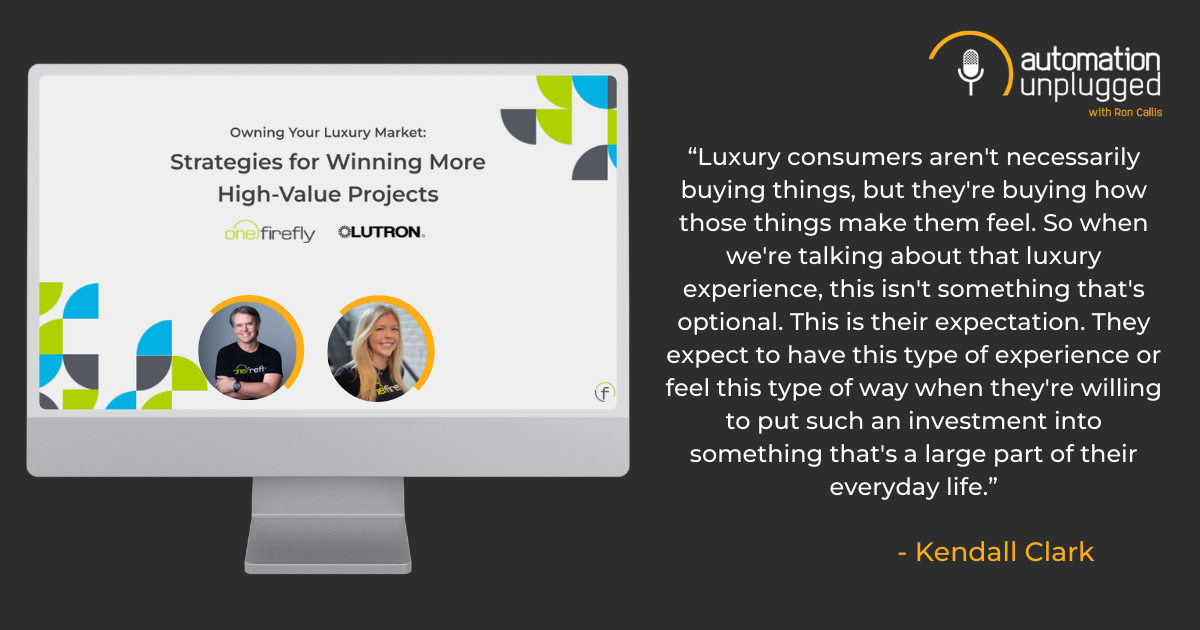
Automation Unplugged #347 is a marketing webinar we recorded in October 2025. In this educational session, we cover what it really means to sell to the luxury consumer and how to create an unforgettable client experience across multiple touchpoints.
This week's episode of Automation Unplugged is a webinar we recorded in partnership with Lutron in October 2025 called “Owning Your Luxury Market: Strategies for Winning More High-Value Projects.”
In this session, we dig into what it really means to serve the luxury consumer — not just by selling premium products, but by delivering an experience that feels thoughtful, elevated, and unforgettable at every touchpoint.
During this session, you’ll hear from myself and Kendall Clark, Senior Director of Sales & Marketing at One Firefly. We were joined by Laura Jean Null, Marketing Operations Specialist - Residential Luxury, at Lutron Electronics.
About this episode:
In this episode, Ron and Kendall cover:
- What a true “luxury experience” looks like across multiple touchpoints — from your branding, imagery, and website to in-person showroom tours, events, and white-glove follow-up
- How to show up where luxury buyers are researching you online — including Google search, generative AI search, and social — and why unique, high-quality content and imagery matter more than ever
- Event and gifting strategies as powerful tools for deepening relationships with architects, builders, designers, and ultra-high-net-worth clients
SEE ALSO: #346: 35 Years of Aloha - The Pacific Audio & Communications Story
Transcript
Ron:
We are here. One Firefly partnered with Lutron to bring you owning your luxury market strategies for winning more high value projects. So we are, normally, we wait around. There's lots of people still dropping in here. We appreciate that, everyone, but, we've got so much rich content for you. We're actually gonna get going. Hello, everyone. I see all the locations. Los Angeles, Novato. Oh my goodness.
Kendall:
Awesome. I'm gonna kick us off and just remind everybody that we will send a copy of this recording. So no need to take frivolous notes or screenshot. We will send a copy of the deck and the recording to everybody. So, Ron, if you wanna click the next slide, let's get moving.
Ron:
I do, and I wanna say hi to Jimmy. I see Jimmy's here from the metropolis of Lafayette. Hey, Jimmy. Thanks for joining.
Kendall:
Alright, everybody. We have a tight agenda today. We're gonna try and keep us as close to an hour as possible, leave some room for questions. We'll do a very quick introduction, then we're gonna have everybody in this group get together and really put themselves in that luxury mindset before we talk about branding, relationship building tactics, and then, like I said, we'll leave some time to conclude and have some questions. We like to keep the chat open. We like it to have interactive. I don't like to speak to a computer, so feel free to chat with us as we go, and we'll try to answer things live as well. If not, we'll get to it at the end. So my name is Kendall. I'm the Director of Sales and Marketing here at One Firefly. You can see we have QR codes for our LinkedIn profiles. We'd love to connect with you all. And I am joined by the one and only Ron Callis, our CEO.
Ron:
Hello, everybody. Super honored to be here and, to be hanging out with Kendall and Rebecca and LJ from Lutron, and, we're excited to share with you all this fun content.
Kendall:
Alright. And then we also have Rebecca.
Rebecca:
My name is Rebecca. I'm the Corporate Marketing Lead here at One Firefly. Excited to be here with everyone. Couple housekeeping things. As Kendall mentioned, we will send out the webinar recording and deck to everyone. You'll see that in your inboxes tomorrow. And if not, please feel free to reach out to us directly for a copy. I'll be MCing this event. So if you have questions during, please feel free to drop them in the chat or the q and a at any time. Any we don't get to live, I'll be collecting for the end.
Laura Jean:
Hi, everybody. My name is Laura Jean, otherwise known as LJ. I'm on the left side of the marketing team. I work with Matt Singer and Kyle Yamamoto on dealer communication. And today, I'm gonna be going over the dealer marketing credit, otherwise known as DMC. And then I'll pass it to Ron.
Ron:
Awesome. Alright, folks. So I think many, if not all of you know this, but you're generally serving a percentage of society. And the idea is there are folks that are your clients, your ICP, your ideal customers, and they range you know, it's too generalized to simply say folks that are wealthy, but there's actually, like, you know, classes of wealth. From the super wealthy, meaning, you know, they have billions of dollars or hundreds of millions of dollars to folks that have tens of millions of dollars, people that have single digit millions of dollars, and or maybe they don't have millions of dollars, but they maybe have a household income or maybe a dual household income, and they are ultimately customers that you would want to serve. So these are the types of end clients, I'm speaking residentially here, obviously, that you would desire are the people that are reaching out to you to make contact so that you can provide your products and services and your awesome Lutron solutions. I want you to keep that in mind as we progress through this content. And I know we're here right now. What is this? This is mid October 2025. It's a bit of a wonky economy, and so they call this a k shaped economy. Do you wanna know, an economics one zero one explanation of at least what some would say is happening. K shaped means and, again, this is not a political statement. I'm apolitical for the most part. But it's you know, there are people in society you know, a shape like a k, meaning there's the vertical leg of the k, and then there's part of the k that goes up and part of the k that goes down. Part of the society that have assets right now, meaning they have houses or they have stocks or bonds or, you know, art or whatnot, those members of society, probably many of you that are watching, are generally doing okay. Maybe not, you know, great, but they're generally doing okay because your assets are inflating. They're increasing in value. But there also I'm just acknowledging there are parts of society right now that are maybe struggling more. So although, and there's different types of economies and different types of business cycles, I'm just pointing out that there are many, many integrators that we speak to, that Lutron works with every day that are absolutely doing wonderful in business right now. And there are others that aren't, and they're struggling a little bit more. We're gonna we're hoping to speak to all of you out there because we know that you wanna grow your business. And we're still gonna try to give you some perspectives of how to think about your business and your brand and how you can identify that, train that within your team, and then ultimately put that message out to the world so that you attract those right types of customers into your business. Think about your business as a magnet, and you wanna attract that ideal type of customer so that they knock on your door so that you can help them. So I want to take you down a thought experiment here. All of you probably, to some extent, have been that luxury consumer, if you will. Maybe you've purchased a piece of jewelry. Maybe you've purchased a nice purse. Maybe you've purchased a nice car. And I want you to think about those luxury brands and how they treated you. And I'm gonna inverse that, and I'm gonna say how you felt going through that experience. And so I'm gonna use just a a personal experience of mine. It's from, earlier this year. It was over the summer, actually. And I took my wife to New York for a long weekend, we stayed at the Mandarin right there on Central Park. And so that's a five star hotel. It's a nice hotel. And the experience that we had, we had never stayed in a Mandarin before. So for us, it was a one on one experience. And we, of course, entered the beautiful lobby. There's beautiful flowers. You actually had to take the elevator up to the front desk. And when we checked in, just what stuck with me as a luxury experience, and frankly, we're still talking about it today, is that after the person at the front desk checked us in, that she handed us our card, and she she bowed as she handed us our room key, And then she proceeded to actually step from behind the counter, guide us to the elevator, and then she went up the elevator with us to bring us personally to our room. And my wife and I kept looking at each other like, do they think we're royalty? Why are they doing this? This feels really special. And then, you know, the woman gave us a demo of the room and did the normal things, but just it was really memorable, and it made us feel special. And, many of you that have been in one of these stores or been in one of these experiences or stayed at one of these hotels, you've had a similar experience. And now if we go back to the fact that you are serving custom, luxury consumers, they have certain expectations of how they expect to be treated or how they want to be treated. And we're gonna challenge everyone here to maybe think about the way your business acts and operates day to day. And are you at every single touch point demonstrating a memorable experience in the eyes of that customer such that months later or years later, they're still telling that story. And so that would be one of my recommendations for you today is to as we go through this, content, is there something, some aspect of your business that perhaps you could elevate in a way that would make your business more memorable and ultimately would aid in your ability to grow your business? So that's the thought experiment. Now many of you struggle to think about the necessity to invest in marketing in your business. I know that because Kendall and Rebecca and I and our team, we've had many conversations with many of you over many years. And I want you to think about if you're a business serving luxury consumers by the way, this is a generative search result. We'll talk a little bit about search in a little bit. But I just typed in, you can do the same experiment so that you know there's no aiding and abetting here. I just went to Google, and I said, how much on average do luxury brands spend on marketing and advertising? And these luxury brands, often are spending a lot of money, twenty to thirty percent of revenue. I know no one here is spending twenty to thirty percent of revenue. We are not advocating that you spend twenty to thirty percent of revenue. We are advocating that you spend somewhere around two to five percent of revenue. And for many of you, that still might feel like quite a bit. If you are so bold, drop into the chat what percentage you don't have to say your revenue, but what percentage you are investing in marketing or advertising. We'll see who's bold enough to put that out there in the chat. But the idea is here's an example of F1. Yes. I know that Rolex is no longer the sponsor of F1, and now Tag Heuer is the new sponsor. But for years and years, Rolex was the sponsor. And so I just begs the question. I want you to think about why would a luxury brand spend so much money to be the sponsor of an event like f one? Do you think they understand their demographic and their target audience and that some of their target audience might be the fans that are in the stands or the fans that are watching from home? I think the answer is yes. Now if you were to go to Rolex and say, Rolex, what was your return on investment from buying that sign at the F1 race in Las Vegas? It might be hard for them to exactly state, well, my ROI was this. So when you are and I'm we're prop we're positioning that you guys and gals are luxury brands, or you have the opportunity to be a luxury service provider serving your clientele in the marketplace, and there's value to you putting your brand a consistent way in front of your audience, your ideal customers. Right? So, Kendall, I think this is where I pass it to you.
Kendall:
Yes. I think you said it best right here. Luxury consumers aren't necessarily buying things, but they're buying how those things make them feel. So when we're talking about that luxury experience, this isn't something that's necessarily optional. This is their expectation. They expect to have this type of experience or feel this type of way when they're willing to put in such an investment to something that's such a large part of their everyday life. So the thought experiment that we really want to take you all through within the next remainder of this hour is when you think about all of the different touch points through the journey that one of your prospects come to you from when they first find you, all the way through to becoming a customer, and then staying a customer, there are times at every single part of that experience where you can sort of weave in that really white glove service and make them feel special, from how they see when they research you, that design and sales process, the construction process, final deliverables, and how you make them feel right at the end of their experience with you, and then how you touch base with them on an ongoing basis. So today, we're gonna really hit on the bookends of these, the research and services and support. So, Ron, if you want to head to the next slide. The first part of really trying to figure out how do I wanna deliver that luxury experience starts with really understanding and knowing your brand. And your perception is your brand. There is a quote by Jeff Bezos that says, your brand is what people say about you when you're not in the room. So think about that. What are people saying about you when you're not right there in front of them? And, you know, so you may be sitting here saying, I know my brand. My brand is my colors are blue and black. I have a really great tagline. I think there might even be some core values listed on my website somewhere. Your brand encompasses so much more than that. Everything from your mission statement to your purpose, understanding exactly who that ideal luxury client is, making sure everybody on your team knows all of these things. What are your differentiators, and what makes your value so much better than your competitors? And of course, your visual identity as well, that goes into all of the logo and look and feel.
Ron:
I would just wanna add one comment. Yeah. Kendall. I've been and I know we have been in many conversations where clients will go, well, I don't wanna sound like I'm bragging. Right? And then maybe they have won a certain award from Lutron, or maybe they have gained certain certifications or they've had some status. And I'm just gonna challenge you all. Like, if you don't brag on your company, who's going to brag on your company? So it's a wonderful way to market your business is to talk about why you're different and better or superlative in some way. And that way, you never talk disparagingly about any competitor. There's never a good reason to do that. You just talk about what makes your company different and stand out and do that consistently, and that's really where the magic is made.
Kendall:
Yeah. Great point. Alright. So let's start with branding assets, and I wanna position this in a different way in that when you're thinking about your brand and maybe the trifold that you hand out or your business card or you can see here your vehicle wrap, what you're really looking for is both consistency and quality. So think about that experience, that timeline we just showed. Let's say, you know, you're in your neighborhood. You see this nice vehicle wrap parked in front of your neighbor's house, you 're looking to do some work on your own home, so you walk over, you introduce yourself, they hand you this really nice high end business card, you go to the showroom, you're in there, you're starting a great experience, and then they hand you a trifold that's printed out on a piece of computer paper, maybe it's kind of folded, misshapenly, and it it's really sort of this, like, break in that experience where you kind of ruin that consistency, ruin that flow. So think about all of those touch points within your customer and all of those assets and how you can meet that luxury standard all the way through the experience. Same goes to show with your imagery and videography. That imagery, of course, will live on any printed material, but it will be on your social media. It will be on your website. The biggest thing that I hear when we're talking to customers that wanna work with One Firefly is they say, Kendall, how do I make sure that my website, I don't want too many people on my website. I don't want people that are gonna call me for projects that are too small, or, you know, they want me to do x y and z. They want me to hang a TV. It's not worth my time. I'm only looking for this caliber, this level of project, and our response is great. I don't care how many people are on your website, we want the right people to reach out to you. So how do you make your website or your assets that pre qualification tool? As you put imagery or video that is reflective of the types of projects, the types of homes you work in, and the types of projects that you capture. So you want to make sure, if you don't have that, take a look at your site, see where that might be missing, where it might be telling the wrong story of what you're looking for, and go out and capture that content. You can reach out to a local photographer in your area, you can reach out to us, we're happy to help you capture some of that imagery, but you want to make sure that that imagery is reflective of your project that you want to attract, the people you want to attract, and we'll talk about this a little later. It needs to be unique because AI likes that now. Doesn't it, Ron?
Ron:
It does. It sounds a little weird, folks. But not only are the Google bots crawling your website, but now the AI bots are also crawling your site. And pretty soon, it'll be AI agents crawling your site. And they are reading not only your text, but they're reading your images, and they're reading your videos. And they're interpreting that into language that then makes your site indexable by those content. And if that cut that is a powerful driver, folks, for that content to be unique and only identified as on your website. And even the types of homes, it's gonna know the architectural style, the furniture style, the geography. It's gonna look out the windows and know geographically where it's located. It is going to know, which means that you want to put awesome content on your website and on your social media on a regular basis.
Kendall:
Absolutely. And then we'll touch quickly on website. Again, you want to take that nice beautiful imagery, place it on your website, and really with your website, I want you to think of it like a virtual or a digital showroom. As you navigate through it, pretend like you're one of your prospects, and does it deliver that same experience that a showroom might? Or if you don't have a showroom or a place where you're showcasing some of your work and technology, then you wanna make sure your website is built out really nice, so you have a place that you can reference, that you can demo from. There's lots of really good information that you wanna have on that site. So, Ron, go I'll hand it over to you now.
Ron:
Awesome. So thank you, Kendall. So the game has changed, folks, and that there's a new frontier now for raising the awareness and visibility of your brand. And I'm being specific to the idea that customers are doing research. And, yes, they may have been referred to you by the architect or the interior designer or maybe your past client, but that customer is also using this thing called the Internet, and they're doing research. And for years, we, One Firefly, have been exclusively talking about, you know, them searching on traditional search. You know, you think Google search. You also can look at paid search running Google Ads. But in the last three years since ChatGPT came out and now there's Gemini and there's Perplexity and there's Claude and there's all of these different environments, they're also conducting search in AI. So we call that AI search. And these environments are important for your business to show up, and the activities, the investments in time, money, and energy that you have to go into as a business to ensure you're showing up not only in Google, but in the generative search results now from Google. And you actually see a you saw a slide a few moments ago where that was generative search results, and we'll show you another one here in just a minute, But also where you are showing up in AI and I don't wanna get overly technical, but I will break it down for my my super nerds here that are taking notes. In AI, you need to make sure that your business is showing up in what's called the training set data, meaning that, when AI is learning from the entirety of the Internet, your business and the solution service brands offering that you offer are in that training set. But you also want when AI is queued to go out and do web search, you then want to be findable in that web search. So, the good news is it's entirely doable and manageable to make that happen. And if that's currently not in the activities that you're managing in house or managing with your agency, those are gonna be activities that you wanna start investigating right now because AI search, as we'll show you here in a minute, is growing exponentially. But if we do go to what you've all known for many years, which is the idea of showing up in Google, the idea is you want to be found in the top three positions in organic. So there's page one of Google. Ads are usually at the top and or the bottom of the page. Google's always playing with that ad position, and that is wonderful because you can pay to play to be in that ad position. And for many of you, that should be a part of your strategy. But if you're gonna be found organically, you really I'm gonna tell you, it's sad. All that really matters is getting in position one, two, or three. And so if you're in position five or six, you're getting a fraction of the traffic to the people at the top. And if you're on page two, you don't exist. So you wanna be very meticulously identifying the long tail phrases that you wanna get found for and making sure you have a strategy in place. And so what you are is what is doable and this is an example. This is one of our great clients, Lee Travis over at Wipliance. You ultimately want to balance how is your website getting found in search and AI search. You wanna know how it's getting found and how does that match up with the the specialties that your business offers. Let's say you really wanna drive your lighting fixture business. Well, then you need to make sure you've identified keywords and then developed content and content strategies that are ensuring your business is showing up in the way that you wanna get shown up because then we can go into, there's various environments through Google, Google Search Console, where you now can identify, not theoretically how is my business showing up, but exactly what are the top phrases that are leading to traffic being driven into my website. Any good marketer is gonna be able to guide you through this process, and it's really important to match up your business goals, as well with your let me click on the right button here. Your business goals with what is true in terms of objective data.
Kendall:
Now you also luxury buyers are actually freezing that stuff too because how you and I may say it might not be how somebody types it in as well. So tools like that help you really drill down into what are your end users physically typing in.
Ron:
Hundred percent. And so it is easy for an SEO or a marketing agency to simply develop phrases that are so odd or peculiar, they can get you to the top of page one. But you actually wanna be matching page position with traffic. Because where you wanna be is, like Kendall said, what are the phrases those end customers or prospects are searching for, and how am I actually showing up for those where there's search what's called search volume. Now what you see on the screen, this is an example of a generative search result. It is growing exponentially, folks, in terms of Google trying to serve up the right answer based on your search query. So if you notice, this is almost the entire page because I opened up the AI window. This is a generative AI search result. I said, what are the best lighting control platforms for my home? And, convenient for Lutron, there's a lot of Lutron names here on the screen that Google has determined. This Google Gemini has determined our appropriate answers for that result. And if you then notice, these generative search results can ultimately drive traffic back to your website as well because you see there are links. So if you wanna go and, you know, you wanna verify the results that are being served up to you, you, the visitor on the website, can click those links and then ultimately go visit those websites. So we are actually seeing more and more traffic. It's exponential growth of traffic landing on websites coming from AI search engines and from generative search results. Now those numbers are generally still much smaller than Google's search traffic, but they're growing very fast, and we'll show you a graphic to demonstrate that. So you can see that Google, you know, has a tremendous trillions of search results that are happening in Google today. But when you dig deeper, those numbers are declining, but it's still massive. Okay? So it's very, very big. It's going to be very important and relevant for your business for at least the years to come. I don't totally predict the future, but I can see at least the next few quarters. And it's still gonna be relevant. But you have the chat GPTs and all the large language models that are on a meteoric rise. It's an exponential increase in terms of the amount of search volume that's happening there. And as the nuance is, yes, you want to get some of that traffic back to your site, but you also want that brand placement. You want to be the brand, the service provider in your market that has shown up as the authority on the topic that someone is maybe doing general research, often called top of the funnel research. So maybe they don't know exactly what they're gonna buy or when they're gonna buy it, but they are doing general research, and now your business, your service, and solutions are being served up. It's helping to ultimately build the authority and the trust of the people that are doing research in your business. And so here's an example of actually, inside of, this is inside of ChatGPT, someone using ChatGPT as if it was Google. And they're actually going there and asking a similar question to what they might have asked in Google in the past. And I'll just challenge, would you not want to be the company named in the results? Because I know that I told this story recently. I mean, I purchased the washing machine in our house, the washer. We got a new washer and dryer because our old one died. And the decision was made off of the results, a top five table research project that I had done and shared with my wife. And I said, here's top five. You go pick one. And she picked the one from that list that best met, her expectations, and, a purchasing decision was made right out of chat. And that's gonna continue to accelerate, folks. This is not a trend that's likely gonna die anytime soon. And so it's really a matter of you and your staff becoming aware of this new world of online search. We, One Firefly, crafted an education article. Feel free to scan the QR code here. Nowhere in this article do we say that you need One Firefly to help you solve this. You can solve this yourself. You could solve this with other agencies. And, and or if you do want to talk about it or better understand it, we'd love to chat with you and and dialogue with you the ways that you can make sure. There's also a lot of new lingo that's getting passed around. It's mentioned right down here at the bottom. LLMs, AEO, GEO, like, trying to help you translate. What does all this lingo mean, how do you leverage these technologies to make sure your business is visible. Kendall.
Kendall:
Alright. So as you saw earlier, we're now going to shift gears a little bit to talk about your showroom. And, you know, the One Firefly team, we actually just wrapped up our all staff event up in Indianapolis where we had the opportunity to visit an incredible showroom. The Triphase team was so gracious to welcome us into their showroom. Ron, you were there. Talk to us about what just that experience was like.
Ron:
I have been in many showrooms over the last twenty six years, and I just said there's so much to be said for a well thought out space where the staff now in this case, our team these are, like, twenty, twenty five One Firefly team members. We were in Indianapolis this summer, this August, and Robert gave us a personal tour. So I felt like royalty getting taken around by Robert Haecker. And it just the space was stunning. It was beautiful. It was well thought out. There was rhyme and reason to everything that was on display. There was a script of sorts of what gets talked about and in what order, And we ended up navigating around this floor plan and then landed at the lighting lab. And Robert, for example, was educating us that the typical consumer doesn't wake up building a new house thinking they need beautiful lighting in their home. It's usually an afterthought. But when they're brought through this experience and the final experience is helping them understand the difference of beam spreads and color temperature and wall wash and linears, The end of that conversation is every single customer wants to give him a set of plans so that they can design the lighting design for the space. So it was awesome. I mean, there's a lot to be said for a well thought out space and story that aligns with how to go through the space and talk about the space. And I think that's where the opportunity lies for the folks watching to design that into their business.
Kendall:
One quick thing that it makes me laugh because it actually contradicts slightly of what's on the screen that says the moment that your prospect steps inside, sale has already begun. One thing that Robert over at Triphase does is he actually prints out, they have a dedicated parking spot for prospects where they print out the prospect's name, so it's personalized as they're parking in the parking lot. So that sales process has already begun even before they're actually stepping in the door. But it really gets your mind going of how do I deliver this luxury experience in my showroom, and there are so many things to consider. First of all, you want to make sure you have a warm welcome when someone walks in the door. Bring your most friendly person, your most personable teammate, somebody who really knows the space to greet whoever is coming through the door, and anticipate their preferences. If they've mentioned to you, Hey, I'm gonna bring the little kids with me. Maybe you have crayons and a coloring book, or maybe you put a fun movie on in your theater. What a cool experience that would be for them. If it's a second meeting and you saw that one of them was drinking sparkling water the last time we were there, maybe you have that sitting on the desk so that you can offer them, you know, the type of water that they desire when they sit down if they're thirsty. Of course, you wanna make sure everything is working in your showroom. I know that can be challenging. There's a lot of updates. Everything's kind of constantly ongoing, under construction. We don't want to demo anything that's not working. That is not the luxury experience, and that disrupts that pattern of just that white glove experience. So lots of different things to consider, and you wanna just overall be making sure that you are hosting, not selling. Ron, we didn't feel like you know, you were being educated about all of these different components to lighting, but you didn't felt like you were being sold on them. You were feeling like you were in an immersive experience where you're learning all about all of this stuff. Right?
Ron:
It was palpable. I mean, I know many of you on this call sell and operate this way, so I'm not diminishing anyone watching or listening, but I would tell you it was awesome to watch Robert in action doing it, and we even made the comment. My team was observing this, that the experience felt like we were learning every step of the way through the space. And at the end of the day, what Robert's doing when it's a real customer is he's just gauging, are they interested in this or not? Would they want this potentially designed into their project? It was terribly smooth. It was awesome.
Kendall:
Yeah. So speaking of showroom, events are also an awesome way that you can utilize a showroom space. Go ahead.
Ron:
I promised folks I won't read every word here, but I just like, what is an event? It's an in person experience that brings your brand to life, letting people interact with your luxury solutions. I want you to think about incorporating more of these into your life, into your business as a way to help you raise your visibility and drive business. And if you think about the idea that you're bringing the right types of folks into your business, into your event, it's ultimately for a purpose. So maybe you're trying to develop new relationships with architects or designers or other tradespeople, or maybe you're trying to give prospects that are on some level on the line a wonderful experience and indoctrination or introduction to your company. And maybe you want to separately just give thank yous and maintain and nurture the relationships with your clients or trade partners. Those are really the reasons why businesses are often putting on events. Now if you want a cheat sheet, and I know Kendall and Rebecca mentioned you're all gonna get the link to this presentation as a thank you. We'll send this to you so you can download it. But if some of you want a screenshot, this is a really good image to screenshot because these are common types of events based on the target audience. I won't read all of them, but if you're trying to solicit that new architect holding lunch and learns partnered with Lutron or maybe through your CEDIA outreach instructor coursework. It's a great way to get someone's attention and have them help you. Bobby, you're welcome for the cheat sheet. Yeah. Our pleasure. You know, new trade partners, maybe you're gonna have an open house. Maybe you have like, I know what some companies are doing because I was just invited to one in Palm Beach, Florida. A dealer just put on a video wall on display. Another dealer in Fort Lauderdale, if you can tell I'm in South Florida, actually had his Lutron showroom. He got Ketra, the new Ketra fixtures installed everywhere. He was having another grand opening and inviting all of his trade partners to that event. Again, putting on an event, champagne, hors d'oeuvres, music, world class networking with who's who of the design community in South Florida. And those are just awesome ways to raise the way that your audience and constituents think about your business. Now we want you to remember prior to holding the event, you really wanna be particular. Who do you want at this event? And then what are the actions you're gonna take to raise the visibility? Is this a very curated event where it's just you're totally comfortable with, you know, ten or twenty highly curated individuals being in the room over the course of several hours? Or are you trying to do a broader event and you really wanna bring in numbers, maybe hundreds through your space. You wanna look at email outreach, personal invitation outreach, phone outreach. Maybe for some of these people, you actually wanna send a car and pick them up and bring them to your event. These are always good ideas. Just gonna keep it moving. And you do wanna think about, as Kendall mentioned, who are your friendly people that wear a smile? Not diminishing people on your team that don't wear a smile, but maybe you don't want them on the front line greeting people as they're coming into your show space. Or maybe you want your best and your brightest to be the ones giving the demo or explaining the technology or having that critical role in the event. You also have a world, I know many of you like to have your branded swag. We'll talk about swag in a little bit, but this is a great time to have your swag. You could totally have a gift bag ready for people as a welcome gift or a parting gift. Now we are as marketers, so, you know, don't hate on us, but we're really gonna strongly recommend you get first name, last name, and email address of everyone that is actually at your event. And that is not so you cyberstalk them afterwards. That is so that you can say thank you. You can say thank you for coming to our event, and that's just that little touch. By the way, I mentioned the Mandarin Hotel. Would you believe a week after we stayed there, we were back home. We got a personal handwritten note from the young lady that had checked us in. She also had checked us out at the hotel, and that she had sent it handwritten to our house saying that she hoped we had a wonderful stay, and she looked forward to seeing us again. Holy cow. It was fantastic. I mean, it made us feel so special, although I'm pretty sure she does that to everyone. But, we felt special, and that's what you guys wanna do. You wanna make your folks feel special. You do wanna send that thank you, ideally, promptly at the end of the event. And you ultimately wanna talk to your team, and you wanna debrief. If you're ever at a trade show and you go to the One Firefly booth and you visit our booth at the end of a workday, you actually will see our entire team powwowing, and we are comparing notes on every conversation we had with all of you every single day because we're trying to capture that while it's fresh. So if there's things that weren't clear or we need to do better or complaints or issues, we capture it so we can act on it. And likewise, if there's interest of some sort, we wanna make sure that we're serving up. If we made a promise to follow-up with something with one of you, we wanna make sure we act on that promptly. The little tip here, have a photographer, if not a professional photographer, a junior photographer. That means a junior member of your team with their iPhone or their Gimbal, and maybe you're capturing a little bit of social video. Remember, you wanna be capturing it horizontal and portrait on your use case, but that makes for great content for your social media post event. And then this is a bit regimented. It is what yields better results, and that we want you to really think about strategically how do you map out your sequencing of nurture and follow ups, particularly if there's really good prospects that were at an event. Maybe that's a trade partner you're really hoping to do business with, or maybe it's a customer. So designing out that plan in detail and everyone understanding who owns what role, it's gonna help you ultimately get more return on investment from putting on an event because it's a lot of work, and you wanna make sure that your business is ultimately benefiting. So events are all strategic marketing activities for your business. They have a purpose. It is not just a party, people drinking wine and beer, and you call it a day. You can do that, but it's better when you are approaching it around what can this ultimately generate for the business. And the key here is if this is demanding on your team, design a mechanism where maybe you do this once a quarter. Maybe you do it twice a year. But if you're gonna do it, do it really well. Doing a few things really well is much better than doing a bunch of things poorly. You're gonna get far better yield for your business, investing the time, money, and energy in doing it well. And this is an awesome way to build out your pipeline. Here, you're gonna see I'm gonna rapid fire through these. These are a bunch of social posts of great integrators across the country that have held events, and this shows how not only did they hold an amazing event, but then how they promoted that event on their social media. So here you see SAV. SAV not only put it on their social media, they did a press release. There's blog articles on their website. There's beautiful photography. I mean, they are really the best in class. They have an events page. They're one of the very few integrators in North America that have an events page on their website, so definitely worth taking a look at what they're doing. It's really good. You have Wipliance. Wipliance has locations in Seattle and Spokane and down in Scottsdale, and they are actually regularly holding events at all three of those locations. And they just do a wonderful job of reaching out to not only prospects, but existing customers and trade partners, both potential trade partners and builders and desirable ones. It's really an ongoing strategy. This is out of the box thinking here. Here, you see Lelch from GoLelch. That's their website. They actually invited various people to go have a spa day. So, you know, various people at their designers or architects, offices, no selling involved. Let's just go have a spa day. Why? Because at the end of the day, business is about people doing business with people. You know? You don't have to talk about products or services or projects to actually build your business and have you in a position to grow your business because of these activities. This is a classic trade show. This is an event up in this again, and they did is a local little design community trade show. And, again, proper signage, literature, demos, all looked really great. Here's Spire bringing an architect into their showroom and doing lunch and learn trainings. So just not only do they get to give them the education and the CEU credits, but they also get to the architect, in this case, gets to see their space and meet their people, really integrating your businesses. Just a brilliant strategy. Here's Listen Up out of Colorado, and, there was a touring BMW show from Abbey Road Studio, the speakers from Abbey Road Studios, with the Beatles and whatnot. And, so guess what? That's two existing customers and prospects come in and learn from this manufacturer talking about this cool stuff. And a lot of nostalgia involved. They did that in their invites and the way they got people to this event, and then they did a great job putting it out on social media. As GHT out of Atlanta, I mean, they have a beautiful world class space. So much technology on display. Gift bags, they're your swag gift bags, and they are regularly hosting members of the design build community in their space. I'm gonna switch gears and talk about something that is not often talked about, so this might come out of left field, and that is gifting. And the angle I'm gonna be talking about gifting is how to use this as a strategy to get the attention of people that you would like to have their attention. These are architects. These are designers. These are builders, and it could even be potential prospects that you wanna get their attention. It's the intentional practice of giving thoughtful relevant items and experiences to clients, partners, and prospects. What I am not talking about is you just sending your company logo shirt to people. There's a time and a place for that. I'm not gonna knock that, but not really what I'm talking about here. I want you to think about that architect or designer that you really wanna do business with. I want you to think about that architect or designer builder that you love working with. And you wanna make sure that you're top of mind and always thought of in the highest regard. What is thoughtful? The keyword here is thoughtful. What are the thoughtful type of actions you could take that show that you are listening, you're paying attention, and you care about the relationship, or you care about building a relationship. So I'm just gonna give you a thought experiment real quick. What if on LinkedIn, you're following an architect and you a member of a architect team that really wanna be doing business with, you would love to be their go to. And you observe maybe an emotional from the heart message that they did post on LinkedIn, and maybe it was about their child getting way getting ready to go away to college. My son's a junior in high school, so this idea for me is it's only it's not it's a year and a half away. It's very close. My wife and I are dreading it, and hopeful and optimistic. But nonetheless, if someone makes that post and then you see it, and you pick up a book, maybe something that really meant something to you when you went through that life phase. And you write a personal message from the heart about going through that and what it was like for you and that your message online touched them and that you go ahead and mail that first class to their office. Maybe you require signature so that you know the person you intend to receive it receives it. Do you think there's a chance they're gonna wonder who in the world you are and why you just made that act? That's what we're talking about, is using gifting to get the attention of people so that you have an opportunity to build a relationship. On my podcast, Automation Unplugged,I'm the face, but I have an amazing team, including Rebecca, that helps drive the back end to actually make this show possible. But I interview integrators. And recently, I interviewed Andres Klein of Maxicon down here in Miami. And this is in what you see in the picture is a piece of custom artwork that he had an artist fabricate, and he actually gifts these out to architects, designers, and custom builders in South Florida that he would like to earn a relationship with. And so if you wanna hear about that here first person, scan that QR code. You can go watch it on YouTube and hear about his experiences. But I'm letting you know whether you have a large budget or you have a very small budget, the idea is thoughtfulness in the gift.
Kendall:
A reason we don't have the word luxury actually on this slide because we put personalized. Yes. Not like it's not it's about the thought. I mean, it's the thought truly, the thought that counts over the price point.
Ron:
Let's pretend, an off Broadway show comes through your town. You buy two tickets, and you gift them to that custom builder that you've been working with. And you just say, hey. I know you've been working so hard. I want you to, if you know, go have a night on the town on us. We love working with you and your team. We're honored to have that right. And please take this gift and enjoy. I mean, my goodness. They're gonna think you're the bee's knees. So I want you to think about Gifting, and I'm gonna challenge some of you. This is where you might throw tomatoes, not only to do this during the holidays. Why? Because everybody is gifting during the holidays. Gift at other times, key touch points, unexpected times. That's when it's ultimately gonna get people's attention. And then we want you to think about now that you've gifted, there does need to be a strategy in terms of how you then are following up to try to ultimately earn that relationship. So this is where the science gets into it. Yes. You can gift, but then maybe a sequence, you drop a LinkedIn message, and then maybe you drop off a handwritten message to their office, and then you leave a voice mail. And, yes, persistence pays. And at some point, it is a high probability they will say, yeah. Let's meet for a fifteen minute coffee. Let me see what you're all about. And that's what you're going for here. So in Andres’ words, he said, I can tell you that for every delivery, that's of his artworks and gifts. By the way, he has lots of different types of gifts. He has a gift where he gifts hourglasses, and his message is a personal note about time and about how time is finite and you need to spend time with people that matter. How thoughtful and beautiful. He'll talk about that on the podcast. And his open rate is spectacular, and they've just continued to accelerate their investing in this strategy. Gifting is a strategy, not swag. Lots of reasons. Gifting is a really awesome way, not often practiced, that can lead to your growth. This is a great book, Giftology. I read this many years ago. Highly recommend it. And by the way, in terms of gifting, just a personal note sometimes. That's a thoughtful gift. It costs you very little. Cost you stationary. You don't have to, you know, give out steak knives per se. And then we at One Firefly use this website. This is really fun it's called thanks. Kendall, is it thnks dot com? There it is. Thnks dot com.
Kendall:
Dot com without the a. Essentially, it's an easy button where you can select a type of gift, everything from coffee to, you know, high end alcohol and everything in between, where you can very easily customize the message and send it to a recipient through email, and it notifies you on opening and all of those activities.
Ron:
So gifting is awesome. If you're not doing it, add it to your arsenal. Now I'm gonna hand it over to LJ to talk about Lutron DMC, your marketing dollars that you all worked really hard to earn. Laura Jean: Thanks, Ron. So, yeah, let's get into the DMC process. We've tried to make the process for using it super easy and the reimbursement process easy as well with these three steps. First, you're gonna complete your work with one Firefly, then you'll submit your paid receipt to Lutron, and then our Lutron team will receive it. You'll apply that credit, and then the Lutron quick Lutron job we'll have on file. And then if you skip to the next slide, I'll go into a little bit more detail. So when you go into my business, there's a tab at the very top that says you click on the DMC tab, you'll get this view and be able to see the credits that are available for you. And then when you click on redeem credits, there'll be a couple simple questions you'll have to answer, you know, and you'll be prompted to ask. We'll have your invoice and receipt that you're gonna have to submit and then with about twenty four hours this will be reviewed by our Lutron team and your redeemable funds will be updated. Now if you don't have the DMC tab on your my business portal, please reach out to your sales rep. Sometimes this is just like principal level access and your sales rep will be able to work with you on this. And then finally, just a quick final reminder for DMC. The funds will remain available through December thirty first, and this is the perfect time really to use these funds to grow your business before end of year. Don't know Ron's gonna talk about it, but do not wait till December thirty first to use these credits. Okay?
Ron:
Don't be that person, folks. Don't be that December thirty first person. Laura Jean: People will be on vacation, and utilize your relationship with One Firefly. This is why we're using them right now. And now I'm gonna pass this to the team, and they're gonna go over the One Firefly credits.
Kendall:
Yes. The countdown is on, and I know we only have a couple minutes and lots of questions here. So those of you who are status Lutron dealers, you also have some additional One Firefly money because of this wonderful partnership we have with Lutron. Ron, if you go to the next slide here, if you are any of one of these levels, then you have this level of One Firefly dollars to apply towards any Lutron related marketing initiative with us. We take that right off the top of the cost of your investment with us, and it's a fairly easy process. So, again, we just wanna emphasize, click the animation, Ron. We don't want you to spend. We want you to invest in your marketing dollars. If you are making a purchase with your DMC, I want you to attach the word why behind it. If you can easily answer that question why, it is a good investment. If you are buying a trifold and you're like, I don't know what we're gonna do with them, it's not a worthy investment. If you purchase a trifold and you say, hey. I wanna hand one of these to every single person who walks into our showroom door, great. You have a great reason for using that investment towards that effort. So really just think about the why behind it.
Kendall:
So that's it. We are One Firefly. We've been helping technology professionals grow, integrators grow just like you guys since two thousand seven. We have a wonderful team on staff, and I know we've got a ton of questions, which I'm loving. And we have four minutes now, but we will stay on as long as we need to answer all those. So thank you guys again for joining.
Ron Callis is the CEO of One Firefly, LLC, a digital marketing agency based out of South Florida and creator of Automation Unplugged. Founded in 2007, One Firefly has quickly became the leading marketing firm specializing in the integrated technology and security space. The One Firefly team work hard to create innovative solutions to help Integrators boost their online presence, such as the elite website solution, Mercury Pro.
Resources and links from the interview:


