


#349: Selling Emotion, Not Gear — Mastering the Luxury Experience with Doug Dushan
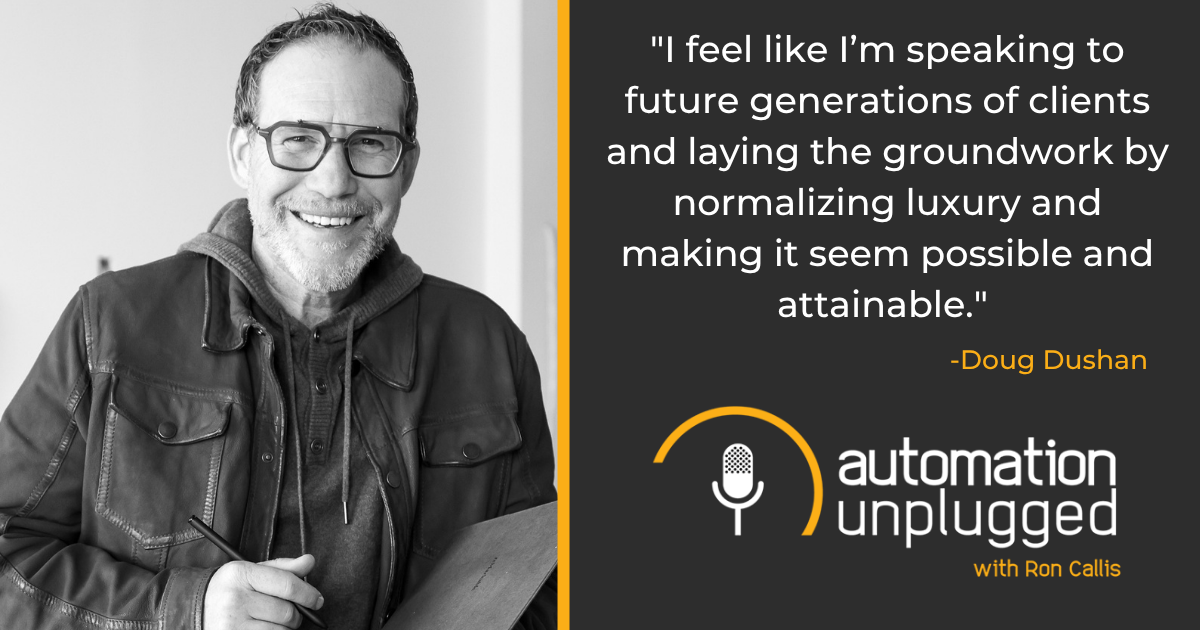
For Automation Unplugged #349, join Ron Callis and Doug Dushan, Managing Partner at Simplifi, as they explore the intersection of culture and technology.
This week's episode of Automation Unplugged features Doug Dushan, the Managing Partner at Simplifi. Doug’s journey in luxury began as a wine specialist and art gallery owner before he entered the home technology industry in 1998. He was instrumental in helping scale Echo Systems from five employees to 86 thru 2022. He then moved onto Paragon Systems to be a lead sales specialist in their elite Aspen market. In Jan 2024 he returned his focus to the Midwest to partner in Simplifi, expanding into the Omaha Market. Doug is also a social media standout, with over 120,000 followers across TikTok and Instagram where he shares his passion for luxury technology.
About this episode:
In this episode, Doug and Ron discuss:
- How his background in luxury goods like wine and art allows him to connect emotionally with affluent clients and sell a lifestyle rather than just technical gear.
- The strategic challenge of scaling a business while maintaining the high-touch, personalized "owner experience" that luxury clients expect.
- Why he uses his viral social media presence as a form of "social proof" to build credibility and reach the next generation of technology consumers.
SEE ALSO: #348: Scott Smith on Scaling Your Business Through Lighting Partnerships
Transcript
Ron:
Hello, hello there. This is Ron Callis bringing you another episode of Automation Unplugged. I know the day or the week that we're going to be releasing this show is Easter week, and so I'm going to wish you all happy Easter. What makes this show super convenient is that we're actually recording pretty close to the date that we're going to take this live. A lot of times when we record Automation Unplugged, we are doing our best here at One Firefly to produce as much content and interviews for you all, folks that are watching and listening to try to bring as much value. And I mean, sometimes shows get put in the bank, if you will, and we air them later and sometimes we don't even know when we'll air them, but we know we'll air them. This is a show that we're recording within a week of taking it live, so it means it's as real time as you're going to get with Automation Unplugged. As always, Automation Unplugged is brought to you by my day job at OneFirefly and AmplifyPeople. That's our hiring division. And both of those businesses are here to serve the integration and security communities and help you guys grow. I appreciate you tuning in. I know you don't want to hear me banter anymore. So without further ado, let's jump right into our guest. Today we have the one and only Doug Duchamp. He is the managing partner at Simplify, and they are out of Omaha, Nebraska. And Doug is an industry veteran, and I know I'm going to learn something, maybe many somethings in this call, And, hopefully, there's something here for all of you tuned in. So let's go ahead and bring in Doug. Mr.Doug, how are you, sir?
Doug:
Ron. Ron Callis, nice to see you.
Ron:
You and I ran into each other. Where did we run into each other? How did this materialize?
Doug:
Yeah, yeah, obviously, know, been in the industry for a long time, so it's hard not to know that, you know, notable faces such as yours, but we ran into each other again at an origin event.
Ron:
We did, we did. And it was a pleasure. I recognized you right away. You recognized me and it was awesome to be able to. And in that event and in that environment, we were able to spend some time and really catch up.
Doug:
yeah, yeah, for sure.
Ron:
As soon as you were reminding me of the adventures of Doug Duchamp, I was like, holy cow, we have to have you on automation unplugged. You were very kind and you agreed to come on.
Doug:
Yeah. Well, thank you. It's a great opportunity.
Ron:
Doug, let's bring our audience up to speed. Just a quick nickel tour of Simplify. Tell us a little bit about the business. What type of projects do you guys do? Again, where do you do those projects and such?
Doug:
Yeah. So we are I'm located in Omaha and my partner started the business going on nine years ago now in the Kansas City market. So Omaha is a relatively new division. I guess we're going on about two years here in the Omaha market. Omaha has quickly become a larger market than Kansas City, which surprises many. It's quite a bit smaller city, but Omaha has always been a very surprisingly lucrative market. And yeah, focused on luxury residential with projects from five and six figures to seven figure projects. Kind of following where I take jobs is focusing on aesthetic and really drilling down on the designer relationships and architect relationships and trying to bring an extra measure of attention to detail to projects as many other integrators strive to do.
Ron:
Do you with Simplify, because you have a history in our industry and we're going to dive into a lot of that. I'm excited to kind of go into that history of where you come from that brings you to the present. But within your current business, are you generally finding most of your projects that your division is executing is there in that Omaha market?
Doug:
It is, yeah. So I'll have a like many affluent communities, you have clients that have vacation homes in Scottsdale or California or Aspen, have you. And so because I have relationships with integrators all over the country, many times where possible, I will refer a relationship to a trusted partner. But sometimes the client insists on us doing the work. And I've got a daughter, it's soon to be two daughters in California. So a handful of jobs on the West Coast that give me an excuse to go out and do some work and visit my daughters.
Ron:
And to your level of comfort, what are some of the typical brands like manufacturer brands within our industry that you design into your projects just to help, again, the audience connect with kind of some of the work you're doing?
Doug:
Sure, sure. Yeah, Lutron is really kind of chief among and when we talk about my history, Lutron is an interesting part of the reason that I took the opportunity to come back working in the Aspen market to Omaha, I saw a real opportunity and that's really been born out. So big part of our, think we grew by a little over three hundred percent just in the past year with our Lutron numbers. Wisdom Audio, the guys at Wisdom have been friends and partners of mine for years and I love them, I love their products. Crestron is an important vendor of ours. And I could go on and on.
Ron:
Those are good three good flagship Yeah, Not that anything you didn't go into detail, not that they're secondary, just I appreciate you naming a couple.
Doug:
I was having kind of an Academy Award moment, where I'm like, who am I forgetting to thank right now?
Ron:
It's always difficult. Don't always remember to ask every guest, but I try to ask many of our guests that question. I agree, is an Academy Award. It's a catch twenty two. You're gonna get in trouble for not having mentioned somebody.
Doug:
Yeah, yeah.
Ron:
Hear about it later.
Doug:
Rep is gonna reach out to me on April first. Exactly.
Ron:
All right. Let's go back in time just because you have such a fascinating background in our industry building businesses and doing awesome projects around the country. Tell us your story and then I'll bring us into some of the topics that I want to cover here.
Doug:
Yeah. Well, I'm not supposed to be here because I was supposed to be down a different path, right? So my educational background, my degree in college is in political science and international studies. And I was a minor in political philosophy and was on a full on path to the foreign service and diplomacy. And I decided to take a break before grad school, I was looking at a program at Columbia or Notre Dame has a program for essentially future ambassadors. And was where I was going. And this industry got me. I responded to a one ad wanting to do a summer job before grad school. And it was looking for someone with experience in luxury goods sales that caught my attention. And in college, I was in the wine business. I sold California wines at a luxury wine shop and knew an extensive amount about fine wines. And I'm like, okay, that maybe qualifies me. And I walk into this two channel, a high end two channel store. And I had no earthly idea there were twenty thousand dollars CD players and forty thousand dollars amplifiers and on and on. And in my interview, we talked about wine the entire time. The owner of the company and I just went on and on about wine and the guy would not leave me alone. He would call me two, three times a week. He's like, no, you're the guy. I'm like, I'm really not the guy.
Ron:
Was he asking you about wine or was he asking you questions?
Doug:
No, that point he was like, need to come to work. Yeah, he thought if understood how to sell high end wine that I would understand how to sell a twenty thousand dollars CD player. To his credit, he was right. He was right. But yeah, a guy would not leave me alone. And it's nice to be wanted, I guess. So I took a job and intending it for it to be a summer job. And twenty five years later, I'm at another end of this same industry. So I kind of accidentally got into it and I guess the rest is history.
Ron:
And what market was that? Where was that shop that you got
Doug:
Omaha as well, yeah. I graduated from college in Omaha and
Ron:
All right, well take us through, where did you go from there? What did you do next?
Doug:
Yeah, so I was there for, I dragged that company into automation. I had a Crestron rep that came in and I'm very I'm the guy that waits around and yeah, yeah, Craig Gully.
Ron:
Yeah, I know Craig.
Doug:
Craig came in and I immediately, we were just a two channel shop and just a two channel shop, but the potential that I saw in Crestron and automation and from a creative standpoint, it was very appealing to me. Like, wow, I can think outside of the box. And so I, which is a dangerous thing when you're a relatively limited knowledge sales guy early in my career, and you're told that you have this really powerful tool to make promises. And then of course, there's the poor guys that are trying to execute my promises. The wisdom that comes over years is knowing where that fine line is, of course, of what promises can you make and keep. So yeah, we grew quite a bit and I don't remember the size of the company, but certainly we grew by three hundred percent or so, three plus over about eleven years that I was with that company. Brief segue, at the beginning of my career, was in the art business as well. It's relevant just in case we talk about the aesthetic side of my focus in my career. So in what way were you in That kind of happened. So right out of college in December of 'ninety eight is when I started in this industry. In two thousand and one is when I opened an art gallery in downtown Omaha, a contemporary gallery. And I operated that till about two thousand and five while I was still at this shop called the Sound Environment in Omaha. They've been around sixty years now or longer maybe. But yeah, so I had a little stint in the art business and still
Ron:
doing Is that a experience? What you learn in running an art gallery for five years or whatever that time period was?
Doug:
Continually learn a lot about people's desire to be surrounded by beautiful objects and luxury in general. Again, having gone from wine to then high end two channel. And what I recognized at that time was that a lot of the affluent populace in Omaha was buying their art in New York or Chicago, maybe LA. And a lot of the galleries were showing local art. And Omaha is just that size of city where it's kind of like, kind of a local centric. And there are some phenomenal world class artists in Omaha without a doubt. But one of the things that was fun was going to like many things in my career, I just make it up and do it because I follow my gut or I follow my passion. And it was very much that way in the art world. So I found contemporary artists from New York or France or Germany or Asia and would bring them to Omaha. And I didn't know anything about house music. And so I would start experimenting, bringing DJs in. Again, two thousand and one was pretty early for Omaha to have a DJ spin in when people would walk in the door. And so I was learning together with the rest of the Omaha community about different genre of life. And so doing graffiti art shows and partnering with Red Bull, I was just making it up. Honestly, I just made it up as I went and it
Ron:
Sounds like you were pushing culture forward though in Omaha at that time.
Doug:
Pushing, but through my own exploration. It's not like I had this like, hey, I'm gonna get the rest of Omaha up to my speed. Literally, I was like, what's this? I've got this forum, I've got this canvas. And so that really was my art, picking the artists and it was a careful balance of finding things that are saleable and then having another show that would piss people off or push the boundary or was controversial or to start a conversation. So, yeah, I feel like I got to play a little role in that, in exposing people to music and visual. Art, definitely art, the aesthetic, but it was really, it all comes back to just exploring relationships with humans and having conversations that are intellectual, that are esoteric, that are aesthetically oriented. And that's the funnest place for me to connect with people is, what do you think of this or that? So that was a great venue for We're
Ron:
gonna come back to this because some of the things I want to spend time with once we capture your story is the art of selling luxury. And I think you've really tapped into something and you were tapping into it early, which is when you're dealing with customers that for the argument's sake could buy whatever they want, whenever they want, however they want, you have to do something then to stand out and be memorable and appeal to them. Because one thing that I remind some of our clients we work with is these folks shop in the nicest places on earth regularly. They eat in the nicest places on earth regularly. They stay in the nicest hotels on earth regularly. They drive the nicest cars on earth regularly. They wear the nicest things on earth regularly. So it's like, what are you going to do to stand out as a business operator selling luxury goods to these people? You know, there's a way to do that right and a way to do that wrong. So for audience listening and deciding whether you're going to keep listening, we're going to jump into some of that. But before we go there, tell me, great recession. I just look over here at my notes and I see you joined ecosystems back when they were a five man shop.
Doug:
So during the recession That
Ron:
beginning of a rocket trajectory.
Doug:
It was, yeah, it really was. And an amazing time and an amazing opportunity. And yeah, so during the recession, unfortunately the sound environment, the two channel business that I worked for, it was run a little bit like a hobby, as many of the two channel shops can be. And all I mean by that is we ran out of money. And so they couldn't pay, couldn't sustain salaries.
Ron:
The business wasn't cash flowing.
Doug:
Yeah, yeah, yeah. And so, yeah, I went over and I talked to the owner of Echo, it was Echo called Echo Tech at the time. And we had worked together on a project previously where they had done the lighting control and I had done Crestron and automation. And we sat down for lunch and he asked me what my vision was for the future. And I knew that they had backing with some deeper pockets. They had electrical company that owned them and electrical wholesale company. And so I was just honest with him and I told him about a vision for an experience center and how I would use that to sell and to tell a story. And yeah, he called me maybe a week later and said, let's do that. And I said, which parties? Like all of it. So I really, I credit John Paulser, the founder who's now the president of the Guild with really being a visionary and kind of seeing the opportunity and believing in me at the time. And so, yeah, we proceeded to build that business over a couple of years, built out what I think was the nicest showroom in the United States. I think they've since shifted in another direction. Yeah, and we just grew like crazy. Experience Center was a big part of that, seeing sales go from one hundred thousand to five hundred thousand or five hundred thousand to a million. And so as we grew, we expanded into different markets, expanded into the Kansas City market, which is where my current business partner, Derek Potts and the founder of Simplify worked for me. So he was my sales guy down in the Kansas City market and ultimately decided he wanted to go out on his own. Thank goodness, because
Ron:
You found your new home.
Doug:
Now I've found my new home. And yeah, then Echo became, Denizen is the current name, was rebranded as Denizen and moved into the Dallas market. And I understand the Austin market as well and is doing well. But yeah, we grew from five to about eighty six people at kind of the zenith of my employment there. v
Ron:
When did you leave Echo or Denison?
Doug:
Yeah, so about three and a half years ago, I left and I think for me, there was an opportunity in Aspen with Paragon. I had relationships because of being in the guild and HTSA and it's a small industry. I had gone out to do some work for Omaha clients in the Aspen market. And it's just fell in love with the architecture and the art and the climate and it's Aspen. Come on, you know, so
Ron:
it's hard to not love. I'm going to pause it if you don't mind, I just I know there's some people tuned in that are dying to know. What is the takeaway or two that you believe led to the ability of ecosystems to grow at that rate? I mean, that's an extraordinary growth rate from a five man shop. And that, by the way, is a lot of feedback I get from people that listen. They love to know while someone moved into a new territory or they grew a business. How did you grow that business? Is there like an idea or two that you know, you feel confident led to some of your ability to realize that growth? And I know you were one of a team. Yeah. So I'm not sure.
Doug:
Absolutely. Yeah.
Ron:
What did the company do?
Doug:
I think, again, I would go back and I say this carefully because I don't think an experience center is the end all be all or is a requirement for success. I do think that we leveraged our experience center extremely well. It was designed in a way that I could sell by telling a story that wasn't a sales pitch. It was more of an educational experience for the clientele that would come in. And so it would really take you through every genre in our business from lighting to outdoor audio and video to the aesthetic focus of speakers or mirror television, or what have you into taking people back into the production facility, and kind of showing them under the hood and then taking them by the service center and where all the after hours support or remote support is done. So what learned, what was really fun about selling that way is if you're attentive to your potential client and you're reading them, you can tell when they're bored. And so you can move a little faster past that and into this next. And then when they would express interest, you can go a little deeper here. And you'd have the occasional client that is just, when we were really busy, used to liken it to be in like Britney Spears in Las Vegas, doing these tours where they were really exhausting. Because if you're selling with passion and emotion, which is the only way to sell, is to connect with people emotionally, It tells stories and then it is a whole experience. And so people at the end of the tour would be a little fatigued, but in a good way. It was like they just went through an emotional experience. And so that experience center really was, I think an important key to our success. But I think a part of that success too, and I think this isn't just designated to that experience, but I think this is something for our industry is that if we tell a different story that other people aren't telling, if we tell a story with emotion, with passion, if we speak to their interests, things that look nice, things that work well, things that are luxury oriented, and don't sink to the lowest common denominator and say, where do you want your TV? That question comes up eventually. But then I think that it differentiates you from your competition. And I don't mean to speak ill of any of my competition over the years, but I think that we have a tendency in this industry and probably other industries do this as well. You do what you do, you focus on your gear or you focus on the product that you're selling. And the product is really the last thing that I was talking about. The products are just the stuff that we fill in to bring the lifestyle that I'm describing. Because if a client is talking to multiple parties, multiple integrators, what's gonna be the thing that stands out? It's gonna be the guy that came into their house and says that is a super cool piece of art over your fireplace. I mean, if you're honest, don't go in and just lie and say stuff is cool because I mean like or, you know.
Ron:
What I'm hearing is become learned on luxury goods. And if you are, that's helped immensely. Yeah, that's a tool. It's an arrow in your quiver, if you will. That's a tool that can be helpful in your dialogue and your ability to relate to the customer.
Doug:
Yes, and maybe more importantly for them to relate to you instead of just being, I don't know if this come out right or not, but instead of just being kind of the help or a contractor, you're a specialist. You're somebody that can, so when I could talk about art or talk about wine or talk about cars or watches or what have you, that's the stuff they're interested in. And so I've found that I've been able to strike a very fortunate chord with my clients in this industry as they, whether they see me as they're equal or not, it doesn't matter, but they'll speak to me with that respect. And we talk about the stuff that we mutually like. And from there, yeah, again, they're gonna remember that. They're not gonna remember somebody that sat down and went through an itemized proposal about the parts and pieces in their house. It comes to that, but that's not where you start.
Ron:
So bring us you did a stint in Aspen with Paragon and then you transitioned back into the Omaha market. What brought you back to Omaha?
Doug:
Yeah, Aspen was amazing. The experience was amazing. Working in eighty million dollars homes and with a team of that size and scope with branches key luxury markets around the country, working with the top architects and the top builders in the world was an incredible experience. Ultimately it was travel. I mean, I've got a family in Omaha, we weren't planning to move to Aspen. The travel became a little more demanding. If you're an entrepreneur and you wanna grow your business, you've gotta be where the work is. And so I was there every week and my family was not. So I would come home sometimes late Friday night and I would leave the house four am Monday morning. So that's not a lot of time to reconnect with your family. And so anyway, yeah, I took the opportunity, I was referring business to Simplify, my former employee and friend at Simplify in Kansas City, they wanted to move into the Omaha market. And so I was referring business to them and Derek approached me about becoming a partner and the timing was right. And I alluded to that Lutron, did see a kind of a shift in specifiers starting to move towards competitive products. And so I kind of recognized that there was a distinct opportunity to grow Lutron business in Omaha. And so it was largely personal, but there were some strategic factors.
Ron:
You mentioned Doug, I'm bringing us into the present here that you've in the Omaha market, the three hundred extra Lutron business, for example, over a twelve month span. What's different about your approach or the conversations you're having or how you're navigating those conversations that's resulting in that level of uptick? I mean, that's very impressive.
Doug:
Yeah. I think relationship selling, right? So having in the first six months that I was back in the Omaha market, it was all just, here's the thing is everybody's busy. Nobody wants to hear a sales pitch. The AV guy comes knocking on the builder's door or the designer's door. Designers will go down a different road on that. Focus on back to the education outreach angle, but with say general contractors, they've got relationships. What I realized a long time ago is that nobody's a big enough jerk to where they, there are maybe a few. Most people aren't big enough jerks to where they won't grab a cup of coffee. You make the ask very small. We grab coffee for twenty minutes? I'd love to tell you about what I'm doing, hear a little bit more about your business. So leveraging the, hey, I'm back in the market from Aspen. That was interesting to people in the Midwest. So I found that there were very few people that wouldn't meet me for a cup of coffee.
Ron:
What type of people were you asking to have that cup of coffee with?
Doug:
Builders primarily, but occasionally architects, interior designers, again, to approach architects and designers I've found over my career has been more effective to really kind of pursue the CDIA registered outreach instructor route. I I went to the very first class. I'm that old, I think.
Ron:
I want to share the outreach tactic. I know it might be repetitive for some listening, but it also might be brand new for some. So I want to give that my undivided attention. But I want to finish with the builder. Are inviting builders. How did you know which builders to reach out to? How did you do your research?
Doug:
I mean, part of that I had the home team advantage, right? Having been a part of integrators here in the Omaha market, I knew who the players were driving neighborhoods, looking at what signs were going up and really what kind of architecture I liked. Talking to electricians, finding out who's doing the best work and trying to understand who the competition is. And then also not going in and taking everything as a slow play, hoping for the fast play. In other words, going in and saying, look, don't expect to buy you a coffee. And then all of a sudden you're gonna send me three jobs. I'm here, I wanna tell you about what I'm doing that's different. Respect the relationship that you have. And I would just love to be an alternative that you suggest to your clients. And this is probably true of every market, everybody's gonna fail at some point, or everybody's gonna slip at some point. And so you're really, I hate to say it, but you're really waiting for that opportunity for the door just to crack open enough. And for you to be the guy, with one of our most successful relationships, an incredible builder here, Ken Oster Homes. It's a legacy family company, work with the father and son run the business. Son has really taken over and exceptional work, really second to none in this market. And had coffee with him early on. Had a solid relationship with another integrator and I respected that, but he had known me by reputation over the years, so he was willing to meet for coffee. And I would call him every two months and he wouldn't pick up. And I would say, hey, just checking in, no pressure, just reminding you that I'm here, hope all is well, take care. And one day I get a phone call from a client of his and not from him. He didn't return my call yet. And he returns my calls now. But got a call from a disgruntled client of another integrator and this client was like, I didn't sign up for the service plan. And so like, my TVs are out and they won't come for a couple of weeks. It struck me, I'm like in our industry, if your TVs aren't working, I mean, that's an emergency. I mean, that's what we do.
Ron:
We'll call it an AMB emergency.
Doug:
Yeah, yes, yes. First world, qualify it however you want. But if this is what I do, right? I mean, if I was a paramedic, I would respond to a different calling, but TVs are, I guess, like a fractured leg or it's whatever, It's
Ron:
It's Friday night and your teenagers don't have a TV to and your spouse doesn't have a TV to watch, it's a five alarm fire.
Doug:
You need that stuff to Yeah, so I got there within like forty five minutes, got a tech over there with me and we were there till the evening getting them sorted out and of course positive feedback to the builder. And just so happened that this gentleman's daughter and son-in-law were building a notable home in the city and with the same builder. And the rest is history on that relationship. And I would take that to other relationships is really just have a memorable conversation with somebody that isn't like, hey, I'd love to sell you some TVs and we do this and this and this. But connecting on some kind of personal level over coffee. And you've got to, as a salesperson, you have to be, or is promoting your business or doing business development, you have to have a memorable story. It's no different when a kid goes to apply for their first job, or you get out of college and everybody's got the same resume. Tell a story that's different. That's gonna differentiate you from everybody else. To me, that's kind of relationship one hundred one, but.
Ron:
That's super cool. Will you be embarrassed, Doug, or proud if I share with the world your social media presence?
Doug:
Both, But go right ahead. Yeah. Embarrassed and proud. Yeah.
Ron:
All right. I'm going to go there because you a unique personality and presence on social media that I'm going to challenge my audience is probably different than they've ever seen. And I'm going to put it on screen and then there are folks that are listening. I'll talk them through it. But you are on Instagram and TikTok, which is what I'm sharing right now, you have almost eighty five thousand people following you under the Doug's Universe name. You have one point eight million likes. And if I jump over to your Instagram, Doug's Universe, you have almost thirty two thousand followers. All right, talk to me. How did this happen? How did this materialize? What's your approach to social media?
Doug:
Yeah, with kind of the same with the art world, I of, I happened into it and then I doubled down once I started to see some measure of success or value or rather than those things, a more honest answer is what strikes kind of my intellectual curiosity. And so with this, as you scroll through some of the content, that's the embarrassment part of this. Honestly, I would post some things occasionally. I was really on TikTok and social media to look at my kids' feed and post an occasional kitten video or something. And so I posted some CC'd video that I had taken years ago while on I think maybe a guild trip. And it started just within a couple of hours, had surpassed like a couple million views and kind of freaked out because I had my name associated with it and my personal information because I have four followers and none of them were stalking me. And so some things started coming out of the woodwork, people were contacting me. So I changed just the first thing that came to mind was Doug's universe. I don't mean nothing, but anyway, now the thing I would say is, and I've had for whatever reason, the algorithm likes my mediocre content. But my feeling about social media is, and I'm a little disappointed in our industry because when I started to blow up on social media, I reached out to a handful of manufacturers and wanted some support, namely in the form of content or like, hey, help me get out here, I'll film some content. Wasn't asking for a paycheck, have a day job. And my wife has reminded me, I'm a fifty something year old man on TikTok. Thank you, Stephanie. And there wasn't a lot of buy in and that frustrated me because my feeling about it is, and I have had some direct correlations where clients have looked at say my follower count, and that gives me a certain credibility.
Ron:
Marketing term we would call that social proof.
Doug:
Okay, yeah. So there's social proof and I've had clients that have looked at that and wanted to work with me of that social proof. For me, it was maybe a little more esoteric. When I was in the stereo business, was telling you this story earlier, I had no marketing budget and I had no money either made very little money at the time right out of college, and I was probably making in the 30s or something like that. And so I figured I could spend twenty five dollars a week to take out an ad in the Creighton Medical and Law School student newspaper. And I put something that said, luxury two channel or luxury stereos or something like that. And so I had these med students and law students coming in and dreaming and just speculating on what they would do someday if they could. I think a part of me, obviously I did it strategically, I don't know that I knew the success that I would have with that. But those people were, I was there when they made two, three, dollars four hundred thousand a year and they would come back and realize that dream that I helped plant for them and I helped them construct. And that was so rewarding. And so I see social media because I'm passionate about our industry and I don't believe I'm gonna log an extra million in revenue from my presence on social media, it's really kind of a, I feel like I'm speaking to future generations of clients and laying the groundwork and trying to encourage our industry to let's put content out there that isn't just a, it's funny, with some of the content, there's much better content in mine put out by the manufacturers that will have five hundred views compared to my thirty million views. Their content's way better, but that's not what the algorithm is looking for and that's clearly not what people are watching given the viewer count. So I think normalizing luxury, making luxury seem possible and attainable and not so at arm's reach.
Ron:
What frequency do you try to produce content? Let's maybe just try to make this tactical for some folks that are listening. How often do you try to do it? And what's your production? Do you have a fancy camera? Is this pulling out your phone? Do you have a gimbal? What are you doing when you're shooting?
Doug:
No, I would love to say it's more sophisticated. Admittedly, as with many things when I first get my kind of the endorphin attentiveness around it, I pretty focused on it. And admittedly, there's a very real chemistry that happens when you start getting millions of likes or at least there was for me.
Ron:
I think they call it dopamine and probably other sort of drugs firing in your brain. And
Doug:
at the same time, I had some very complex, I was building a business in Aspen and working with really high level clients and with high expectations and eventually coming back to partner in my own business here. So I had some things that were very demanding of my time, throw into that, the travel and things like that. Ultimately, credit my wife, the thing about social media is different than work is that it was a creative outlet and still is a creative outlet. Thinking of the content and how you'd put it together and what music and it kind of harkened back to my art dealing days that you're producing a story or you're producing a piece and there's a fun and rewarding creative element to that. But I'm a consummate artist, I'm a creative guy, so I'm always thinking, well, when that became work, and my wife would point out in a funny manner, like, Oh, I lost you, didn't I? You think I lost you to TikTok, didn't So she could tell when I was starting to check out and check-in there. So I will say I'm a little more strategic now. So to directly answer your question, I think when I grew the lion's share of my follower base, you're at least once a day posting or maybe a couple of times a day, and I am not doing that now. Now it's a little more strategic and trying to find good content. Again, it comes back to a little frustration with our industry I wanted to put a little more of our industry on a platform. And so I was really looking, what I was looking for is I was reaching out to key people at different manufacturers saying, hey, I don't want a polished commercial, I want something from your phone that you think is cool, that you filmed over the last twenty years and text it to me and I'll credit you. And there was just so little action on that part. So it really, it's fun. I continue to enjoy it. I wouldn't say it's a major focus of my day to day anymore.
Ron:
An observation that I have that I'd be curious on your feedback. You created this content under Doug's universe, which is I'm going call that personal branding. Your branding, Doug. Doug, the luxury AV sales guy or luxury automation and technology sales guy versus where you're at today. Simplify, simplify content where you were Paragon. How do you think about just think about our listeners like producing content under their brand and name and the role of doing that versus producing content under the brand of the business? I'm going to say I'm neutral, so I'm going play Switzerland here. What's your two cents on maybe how people could or should think about that in terms of the role of social media? As it relates, let's just keep it as it relates to, say, the industry side, trying to use it to ultimately promote your brand power so that you could be more effective at selling luxury goods.
Doug:
Connecting with I didn't have a canned answer, but this is the first thing that comes to mind, right? Like connecting emotionally with companies is complex and hard to do. Relating, feeling connected to individuals, much more appealing, easy to do. So I would say, look at the followers of Simplify on social media or of companies that I've been associated with, or helped to build in the past. And they're a fraction of what my personal brand has built. So I think people, well, I mean, this is a deeper, more psychological conversation. But I mean, I think a lot of the things that we're attracted to on social media, we're looking at a lifestyle that we maybe wanna emulate or that we're interested in. An individual's lifestyle versus a company brand.
Ron:
A business where you feel by design they're trying to be more promotional.
Doug:
yeah. And if you look at the mediocre quality a lot of my content, you're gonna see how honest it is that I don't really know what I'm doing. I'm just like on there just being a dude. Just like sharing the world that I have the privilege of being in. In the industry that I'm in.
Ron:
I love that perspective. I want to round out with maybe a topic that because we're recording this interview, Doug, in such a timely manner, we're about to post this. So we're very here and now. There's a lot going on in the world. God help you if you turn on the news channel or you listen to the news. It'll tear you down pretty quick. So as recommendation to everyone, turn the news off and focus on your family and focus on your business. And how do you look at the balance of this year? You don't have to have right or wrong answers. You don't have to have a magic eight ball. But how are you thinking about going about tackling business the rest of twenty twenty six and beyond? What do you see in your future from your lens?
Doug:
That's a great question. And my honest answer is to keep a constant eye on how to grow my business without exploding my business. In other words, how to I've a part of companies that have gone from small to very large and I feel, and this is not a disparagement on those particular companies, but the things I recognize that were maybe for me personally associated with larger companies is that when you lose touch with your customers, because there are so many layers involved. I'm an entrepreneur, I grow businesses, I've done it my whole career, I've been really good at it. I feel very blessed to have been good at it. My challenge now is how do I grow but not too big? How do you know when you're big enough? How do you know when enough is enough?
Ron:
That in itself is a whole thread of dialogue. How do you know when big is big enough?
Doug:
So because we're on such an, simplify in the Omaha and Kansas City, but Omaha in particular, at least because that's where I'm at and that's where my focus is, we're really an explosive opportunity. So whether it's the momentum that we've gathered, it's the affluent community talks, selling to the right people, taking care of the right people with the right word-of-mouth. A couple of unfortunate integrators in our industry that have suffered some setbacks that allowed me an opportunity to seize on that opportunity, or to seize on that opening and grow. So I kind of feel like the market is, don't wanna sound boastful, it's kind of ours for the taking right now. Feel like we're on a, it's what it feels like, we're just on a really fast growth track with the right partners. So the thing that I realized in growing up, my grandmother was an artist in Hollywood. I would go out there, I was an actor, I wanted to be a movie star. I was just convinced this was gonna happen. We would drive through Bel Air and Beverly Hills and I'd see the homes with the ionic columns out front and I wanted to have one of those houses. So I've always wanted, had this picture of luxury and how that relates to my lifestyle or what I want for my life. I've been in the luxury industry and have purchased luxury products and owned luxury products to the extent of my means. Going to Aspen right sized all of that. Going out and seeing what unbelievable wealth looks like. The ability to build an eighty million dollars house that you spend three weeks a year in and no aspersions on people that have more power to them. And if I was a billionaire, I very well may have an eighty million dollars house that I go to for three weeks. Honestly, I realized I'm not gonna be a billionaire and I'm okay with that. And it really started me thinking about, what am I striving for? And then of course, and this is more of a kind of a personal realization than a business realization, but being away from my family in Aspen and having that realization at the same time, it's just like, really matters? And I have an amazing life and an amazing home and an amazing family. And so it really refocused me in some ways. And so coming back to build a business, and I'm ambitious and I'm aggressive in business, but it is really kind of keeping at the forefront, where's really my philosophy here. And I think there's a strategic element to it. You grow too big, you're gonna make some people mad, right? You're not gonna get back to them on time. You can't give them personalized service.
Ron:
You can't give them the owner's cell phone. Not if they're expecting the Doug experience, right? You can't do that at up to some scale.
Doug:
Right, so that's my challenge this year, right? Is how do I take the opportunity feels like it's unfolding in front of me and keeping that at a measured pace?
Ron:
Yeah, so it sounds like you're very much inventing that and fielding those opportunities and struggles because it is, you know, I've had this opinion or it's maybe what I've learned to understand in business is that a lot of business success is taking the time to really focus on targets and what you're calling a success versus so many of us. I'm looking in the mirror. I've been guilty many, many times of just being very busy, being busy. And it's so easy to do, like more and more and more harder, harder, harder. But pausing, resetting, really setting that goal. And it sounds like you're in a very fortunate place. You've earned the status in your community and you have the experience under your belt to where you can, God willing, take the business where you want to take it. You and your partner decide to take it and you have the the benefit of choice. You have the choice right now. Always fast or as slow, as big or as little as you want. So it sounds like you're just in that process of deciding how much is enough. Right.
Doug:
That's right.
Ron:
Brilliant. Doug, I want to thank you for coming on the show. I know I even wanted to go into more selling tactics, but I know we went into luxury selling and it was rich with perspective and lessons. Pardon the pun there. Rich on the luxury theme of selling. Yeah, it worked. But for those that want to get in touch with you directly, where can we send them? I know my team, Rebecca, has loaded in a bunch of cards here. We can put stuff on the screen as you are willing to share.
Doug:
Sure, absolutely. Yeah, our website is certainly a place to start at simplify with an I ae dot com. Certainly my cell phone, I'd be happy to receive a call from anybody four zero two eight zero zero seven eight six two. And then my social media handle is either on Instagram or TikTok is dougsuniverse. If I know that more people are gonna now look at it, I'll work harder to start posting again more frequently. But no, I'd love anybody that wants to reach out. Like I said, I like building relationships and I love our community, our technology community, and I love talking to connecting with other dealers and so forth.
Ron:
Thank you for joining me on this episode of Automation Unplugged.
Doug:
It's been a pleasure. Thank you.
Ron Callis is the CEO of One Firefly, LLC, a digital marketing agency based out of South Florida and creator of Automation Unplugged. Founded in 2007, One Firefly has quickly became the leading marketing firm specializing in the integrated technology and security space. The One Firefly team work hard to create innovative solutions to help Integrators boost their online presence, such as the elite website solution, Mercury Pro.
Resources and links from the interview: