


#352: Lighting That Sells: How to Sell the Experience, Not Just the Fixture
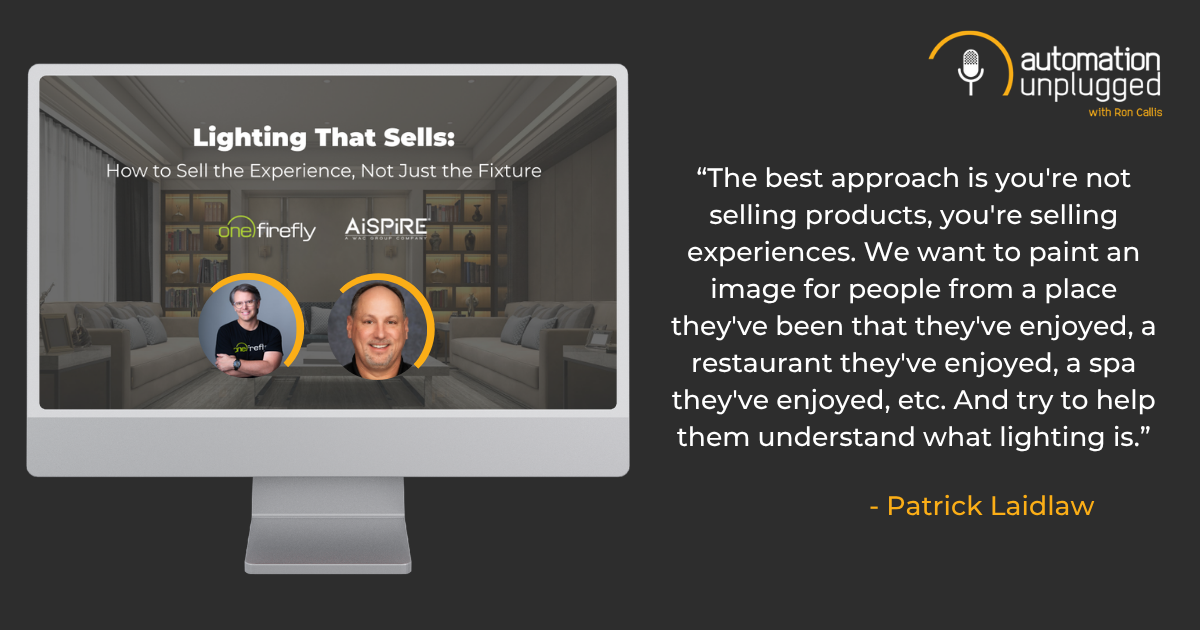
In this week’s episode of AU, guest Patrick Laidlaw of WAC Group joins Ron to discuss The Four Experiences of Light — and how each plays a distinct role in how people live, relax, and interact with their spaces
This week's episode of Automation Unplugged features a webinar One Firefly co-hosted with our partner WAC Group in November 2025, titled “Lighting That Sells: How to Sell the Experience, Not Just the Fixture.”
Lighting is no longer just a line item or a box to check. It’s a core part of how people feel in their homes, how spaces function throughout the day, and how integrators can differentiate themselves with higher-value conversations.
During this webinar, you’ll hear from myself and Patrick Laidlaw, AiSPIRE Sales Director at WAC Group.
We cover:
- The Four Experiences of Light — and how each plays a distinct role in how people live, relax, and interact with their spaces
- How to sell lighting without selling products, using real-world examples like restaurants, hotels, spas, and homes to help clients emotionally connect to the value of great lighting
- How to market lighting effectively, with strategies that help prospects understand why lighting matters, not just what it costs
SEE ALSO: #352: Lighting That Sells: How to Sell the Experience, Not Just the Fixture
Transcript
Ron:
Alright. Let's let's go ahead and jump in. Rebecca.
Rebecca:
Yeah. So as I mentioned, we are gonna take about an hour to go through this content and be together talking about the four experiences of life. So we'll start with some quick introductions, then we'll pass it over to Patrick to talk through what the four experiences of Light are, what they mean for you. Then we will shift over to Ron who is gonna walk us through marketing lighting through storytelling. We also have a couple of different resources for you that we can share with you at the end, and then we'll leave time at the very end for some q and a. And I hope you guys see this cool picture here. This is Ron and Patrick at CEDA of this year in Denver, I believe.
Ron:
This is when we were busy cooking up this idea to do some webinars together. So you you got, we were caught in the act.
Patrick:
That's right. That was a great moment.
Ron:
That was.
Rebecca:
Yeah. So my name is Rebecca. I'm the corporate marketing lead here at One Firefly. I've worked, with Ron for many years, and I oversee a lot of our educational initiatives like this webinar here. I love working in this space and getting the chance to work with very cool people like Patrick and Rachel. As I mentioned earlier, chat is open. Q and A is open. Drop your your questions, your comments. We'd love to hear from you. And if you need to pop early, everyone here will be getting a copy of the recording, as well as a copy of this deck. So you can look for that in your inboxes tomorrow morning. Additionally, you probably see some little QR codes here on this slide. These go to all of our LinkedIn profiles if you'd like to connect with any of us on LinkedIn, and we would love that. Ron, I'll pass it over to you.
Ron:
Awesome. I am Ron Callis, CEO and founder here at One Firefly, and, super honored to be here talking, co presenting with this fine group and for the partnership we have with Patrick, Rachel, and team. And I I know many of you that the names and faces I don't see your faces, but I can visualize your faces because I know so many of you that are here in attendance. And I'm honored you wanted to spend your lunch hour with us. Patrick?
Patrick:
Yes. Hi, everybody. I'm Patrick Laidlaw. Again, I recognize many of the names, on this list, and thank you for joining us. I'm director of business development for the integration division of, WAC Group, and I'm closing in on forty years of lighting now. It doesn't seem like that long, but, but it's been a fun ride, and I think it's the most fun now, even with all the changes that have been happened in lighting over the years. So my goal for today and for this hour is hopefully to bring some information to you that will help you talk about lighting better. We're excited to partner with the One Firefly team to talk about how do we deliver that message to your clients so that it hopefully brings you more business. And, ultimately, the the absolute ultimate goal is is to bring a better experience to clients and better way of life. Hopefully, they the way they live their lives every day. So so let's be evangelistic about this and see how we can help improve people's lives one light at a time, so to speak. So, Rachel, welcome for, you don't do a lot these webinars, but we're glad to have you with us today.
Rachel:
Thank you. My name is Rachel Gilmore, and I work with, Aspire and WAC group in the marketing department. So I get to work on lots of fun things like events and advertising and webinars like this. So thank you for having me today, and, looking forward to share with you some of the marketing assets we have for you to use.
Ron:
Awesome. Alright. Let's get, let's get going here. Rebecca, I think we're gonna get going with a poll question.
Rebecca:
Yeah. Let's do a quick poll. So as you guys know, and hopefully, our this is what you tuned in for, is we're here to spend about an hour talking about lighting, which is one of the, if not the most fastest growing categories in this space, and really how to position that lighting in your marketing and in your messaging. So first, let's start off by just chatting currently. What are you currently doing in terms of lighting business? What percentage of your projects include lighting fixtures or lighting design? Let me go ahead and launch the poll there. You take a second to answer that.
Ron:
Oh, it's fun to watch the numbers come in live. Right now, we're at thirty percent participation.
Rebecca:
Oh, look at it. Keep going. Nice. Let's get
Ron:
the fifty percent participation. This is like record speed, folks. This is a collaborative group.
Patrick:
Let's have some fun. Let's go.
Ron:
Let's
Patrick:
Let's hit Ron's all time high. Everybody everybody click on a bubble there, please.
Ron:
We're right now around where we normally top out. It's about seventy percent participation right now. And, let's see if we can let's see if we can beat that, folks. There's still dozens of you that have not yet voted.
Patrick:
November eighteen. Let's break the record.
Ron:
Let's go. And we do name names for everyone that hasn't voted. Just to, you know, remind you that we're paying attention. There you go. Nothing like a little threat to get a couple more people to act. Don't call me out. Alright. I see you. I see you. See see how I protected your identity? I didn't call your name out. I think we could cut we're at seventy five percent participation.
Patrick:
That's right.
Ron:
That's up there, certainly near the all time high.
Patrick:
Wow. So so that's interesting results. That that means a lot of you are, still fairly new to lighting, and some of you are are definitely more experienced. But, but, hopefully, the goal today is to help everyone that, you know, help everyone sell more and get into that greater than fifty percent.
Ron:
How does this match up, Patrick, with what you see when you're out in the field or or working with your your clients?
Patrick:
Well, right now, I think, Ron, personally, my personal opinion is and and I think a lot of industry people, agree with this. We're past the early adopter phase of lighting in integration, and we're now in the mass adoption phase. We're having deeper conversations. People are realizing just like shading seven, eight years ago, this is here to stay. And there's been many of the buying groups. This is interesting. Many of the buying groups have done polls and studies and run statistics, and lighting is pulling along the rest of the AV equipment with it. So it's really a great opportunity to start and I'll say this really quickly because this is something that I've shared with a lot of integrators over the last few years we've been doing this and that's start with a question. Can you tell me who's providing the lighting on your project so that I can speak to them and make sure that the controls and the lighting are going to work together in the way the client's expecting? So it's a very non confrontational way to address and find out if anyone's providing the lighting, who that is so I can have next step conversations, and then go from there. And and I think that's the biggest challenge as integrators just aren't sure where to start with the lighting program or how to how to find out if there's already a lighting ifier in the job. So that that question alone is just non confrontational, can help you lead to next steps really easily.
Ron:
You're you're gonna take us right now, Patrick, through a way to think about and frame the role of lighting in our lives, and I really implore everyone to lean forward, tune in. Patrick has a lot of wisdom and experience around how to have this conversation with clients, with the end customer, with members of the design trade architects, interior designers, custom builders. He's gonna give you really these themes of how lighting impacts your life, and then I'm gonna follow-up and help you interpret how to take these ideas and put this into your storytelling and your collateral, so you can kind of understand the one two approach here that we're gonna take. So, Patrick, without further ado, I'll let you do the the four experiences of light.
Patrick:
I appreciate that. Yeah. And, Ron, the next slide, I think, will show all of the experiences. Bit well, I guess coming up, it will. Basically, when we started an integration, to give you a just super brief history, we started talking about lighting as lighting people. And it took us longer than it should have, admittedly, to realize we were speaking an entirely different language. And just because we knew what we were talking about didn't mean anyone else did. And honestly, most integrators didn't know what we were talking about. And so it goes to that age old adage about I have a picture in my head I'm describing, but the other person has a completely different picture or no picture at all in their head. So we stepped back when integrators were coming to us saying, my client said, the electrician said the lights are this much per opening or I need this many lights or what how many lights, what size. And we said, do we take the conversation completely away from specifications and dollars and really about what light the role light plays in people's lives. And so this is a very basic statement. I won't even take credit for it, but really we're not selling products. I've only heard a very few integrators say, oh, there's, you know, there's so many speakers in a house, but look at all the lights and look at the opportunity for how many holes in the ceiling. And I'm not saying that's the wrong approach, but it's gonna be hard to sell with that approach. The best approach is you're not selling products, you're selling experiences. We want to paint an image for people from a place they've been that they've enjoyed, a restaurant they've enjoyed, a spa they've enjoyed, etc. And try to help them understand what lighting is. Everyone lighting comes with a house. You walk in, you flip a switch. You might have to take a piece of paper and wander around and say I can't see anything in this kitchen and find a light to stand on under, but they don't understand there's a better way. So we said, let's talk about the facts and let's talk about the experiences. And we came up with what we call the four experiences and this is how we recommend all integrators at least start and talk about lighting. The trade names you see on those experiences, even if you never remember those, this I believe this concept and this way of selling lighting or telling people, talking to them about lighting is the best way. And so our trade names are Alpine, Astro, Aurora, and Atmosphere, but ultimately think of it as static white, dim to warm, which is like an incandescent or halogen bulb, color and tunable white. And so we want to talk about, you know, ultimately you don't do the same thing in every room of the house. Why are you putting the same lighting in every room of the house? And so it's all talking about the experiences themselves. So let's walk through the experiences, and you can ask leading questions with with your clients. Like, do you want retail lighting in your home? And most clients will shake their head, yes, no, back and forth. They they know it's a trick question, but they don't know what the right answer is. And the answer is yes. We do want retail lighting in your home. Retail lighting is what we call static light or static white. And so it's a fixed color temperature, let's say three thousand like the color of halogen. As you dim it down, it becomes less intense, but it doesn't warm up. So there's no mood or emotion. It's kind of makes the room feel gray or foggy. So, yeah, you can make it less bright, but it just feels weird. It's not intuitive for us. So when we say, you know, do you want retail lighting in home? Customers will say no. And you say, well, we really do. One, it's a benefit to you because it's the least expensive kind of light that you can put in your home. So we're gonna save those import those budget dollars for other important rooms. So it it's a it's clear. It's for task lighting. Where do we use it? This is the key. We're gonna use retail lighting in your laundry room where you sort socks, black and blue socks. You need good lighting in there. You don't need mood or emotion. We're gonna use it in your pantry where you're like in a grocery store. You're going to find ingredients. You wanna be able to see everything. You typically don't dim a pantry down. We're going to use it in your storage areas, closets, you want to see your blue blazer from your black blazer. But again, typically we don't do for most cases mood lighting in the closets. And then again, the garage to go get a shovel or wash a car, you don't need mood or emotion. So the all those spaces, we're gonna try to save budget dollars and put in what we would call retail or static white, light.
Ron:
Patrick, can I ask you a quick question?
Patrick:
Yes, please.
Ron:
So none of these four categories are good or bad. They're just different.
Patrick:
A hundred percent.
Ron:
But even within this category of static light, there is still a difference in the type of light or the quality of light or the even the fixture trims or details. Right? And I'm just, like, comparing that. If you go into a normal, certainly, semi custom home and you get four cans and a fan, that arguably is static light, but there's I mean, even then, there's grades of static light. Is that correct?
Patrick:
Yeah. Correct. And that's a great question. And and by the way, everybody on board, we didn't practice this. So this these are good questions. Yes.
Ron:
Both Patrick, anybody that that knows me or listens to my podcast, they know that I 'm asking you because I'm curious. Yeah. I just wanna know for myself, and I'm hoping some others would benefit as well.
Patrick:
Yes. It's the absolute truth. So we're talking about the experiences of light or the kinds of light, which, by the way, these four kinds of light, I just wanna add, are universal. So even if you don't ever buy from the WAC group or Aspire or you sell a different manufacturer, there's four kinds of light. These four experiences or four applications still apply. So it we shouldn't be talking about brands. We should be selling people on what they can have, how they can live their lives better. So, yes, to your point, Ron, recessed lighting is supposed to be up in the ceiling. And over the years, especially in certain markets, it's evolved into the least expensive type of light I can buy. I'm gonna flood the room with mashed potatoes. Everything's the same. There's no mood or emotion, no drama, and every light gets the same little bubble on the ceiling or or flat lens. And so I like to ask people, especially depending on the age of your client, do oncoming headlights bother you? When we talk about the quality of light, do oncoming headlights bother you these days? And if they're over forty five or fifty, they're gonna say, oh my gosh. I can't see anything at night. Well, we certainly don't wanna let anyone put these bubbles or put headlights across your ceiling. And you sit to relax and have these all these glare bombs across the ceiling. So when you step into better lighting, it will be higher up in the ceiling, what we call that regress. And so you'll get less glare. We call that a quiet ceiling. We want the ceiling to be as quiet as possible because who wants to build a beautiful home and look up? You want to enjoy the surroundings. So that's a great question. There's definitely different qualities of all these experiences. So again, here's where you might use those experiences, you know closets, obviously pantries and then laundry rooms. Again, any basic space that storage rooms and things like that, we're gonna save those dollars and we just need light in that room. That's okay. So when we get into the next experience, it's called dim to warm and dim to warm should be an intuitive experience that we're all used to, especially depending on our age. We grew up with incandescent light bulbs and then transition to halogen light bulbs and that basically as you dim it down, it can be done with just a regular phase dimmer or wall box dimmer. As you dim it down, it becomes less intense but also swings to a warmer color temperature. It should replicate the incandescent or halogen dimming curve. And places to use this are anywhere we want mood and emotion. So bathrooms, bedrooms, dining rooms, you can use them at home theaters. I like to tell the story. And, again, remember, people relate to stories. They can repeat stories, and they'll also come up with their own stories when you share your your stories. You know? If you ever talk about fishing or deer hunting or sports, the other person usually comes up with something similar that they wanna talk about. So I always talk about, and this is a true story, I talk about my wife. She likes to take baths. I'm a shower guy. She likes to take baths. She doesn't wanna come home at the end of a long day and have a glass of wine and and sit and take a bath in Walmart white. She wants candlelight. She wants to relax and unwind and you can't do that with static white light. So dim to warm allows you to be able to dim the light level down and warm those up and be able to enjoy the atmosphere. So sharing with friends, hanging out, any of that stuff, just relaxing at the end of a long day is a place we'd use dim to warm. So again, it naturally fades, catch up in bed with a book, to kind of relax. That's what where dim to warm is. And by the way, it's the second least expensive light experience that you can have and it's just in phase dip. So after the astro go ahead, Brian. Go ahead. I was gonna ask a quick question and this gets into, I I think both in this category and and maybe the atmospheric category. But the idea that later in the evening, you want to and I I could be totally misstating this. You wanna increase your exposure to red light or decrease the exposure to blue light, and that will improve your ability to sleep. Does that play into the storytelling around ASTRO or the warm the warm Astro, it does apply to Astro in two ways. So you're absolutely correct that the less intense and warmer color temperatures tend to have less of an impact on circadian rhythm, you know, disrupting your circadian They'll use amber, real warm amber tape light around door frames and over toilets in dementia and Alzheimer's patients who don't have a regulated circadian rhythm. And just even a little white light can jolt them out of of their sleep pattern. So having it warm in the bathroom, when you get up to use the restroom at night, the last thing you want is blaring white light burning your retinas out, number one. And number two, to your point, disrupting your circadian rhythm. So just even if it's a slide dimmer on the wall or today's integrators use a home control system, you hit the bottom button and it just comes on low and warm and absolutely for things like that. A night light when you have guests, there's lots of different places for dim to warm. So the next experience we move into, those first two experiences were phased in. So for the integrators on this call, they're phased in so you can use phased in modules or whatever. If you're doing a retrofit, if it's a six inch can, you're putting in retrofits. We have dim to warm retrofits that you can pop in and they'll work on the existing wall dimmers. But the the next experience, and now we're elevating, is tunable white lighting. Tunable white can be used for lots of different reasons. But basically, what it does is it max it can maximize an appearance how something appears by sliding between warm and cool color temperatures. And when you're explaining it to clients and and they don't necessarily understand the difference between warm and cool, I found one of the best ways is to say, think about your painting. So you have this blue ocean with this fiery sunset. Think about your painting. If you go out at midday and hold that out in your yard, the blue ocean is gonna be the dominant, you know, portion of the of that portrait you're gonna see. And then if you go out at sunrise or sunset, because the light the color temperature is warmer, the reds and yellows and oranges are gonna be accented and tend to look on fire. And so tunable white allows you to slide between warm and cool. So let's say sunrise in midday or sunset in midday, and that affects how things appear. So you have brown fabric with orange pinstripes. If you go cool, it washes out that rich brown fabric and certainly hides all the orange pinstripes. And as you slide warm, the orange pinstripes start to come out in the fabrics. And so it allows you to not only maximize all your interior designers work to what it's really should look. Like, don't take it outside and look at it unless you're gonna put outside lighting inside. We can make things warmer and cooler, and we can do it individually because now we're using digital communication, DMX. So each light is individually addressable. So I can make the one on the couch warmer. I can make the one on the the painting cooler, and then I can also make a daylight scene. So the whole living room with the bank of windows looking at the ocean goes very cool and you feel like the outside is inside. You're standing on the beach. So again, it brightens as you wake naturally, midday light, and then you can also set circadian rhythms if you want circadian rhythm lighting so warm. Think about Saturday morning, you roll over in bed and you hit the sunrise button. In over twelve minutes, the light goes from warm to cool to help you wake up naturally. You hit the sunset button preparing for sleep, and eighteen minutes goes from cool to warm. Science tells us we should really try to start doing that at about two hours, getting away from intense light in our face and and and warming up. But still, you can have there's an emotional portion of that that goes along with it. So tunable white's a more expensive experience no matter who you purchase it from, but we're gonna use that in the the great room, maybe the primary bedroom for sunrise sunset, so the important rooms of the house. Unless your client has an unlimited budget, they could do the entire home and we have done that. So yeah. So that that's the opportunity for for tunable white and it's a digital experience.
Ron:
Yeah. Eric just made a comment, Patrick. He said, people that work odd hours, for their offices, that adjusting the the circadian rhythm lighting in their home to match their personal schedule, that could be a neat application.
Patrick:
Absolutely. If you need to be awake at four AM, you know, you can go to cooler color temperatures or, you know, we're we're actually gonna be, working with the light the, Light and Health Research Center, bringing some more webinars next year, and one of them is on shift workers. The impact light has on shift workers. So absolutely if you want you need to be awake or you need to be alert to practice, you don't want to do it in dim to warm light unless you have turned all the way up to its coolest color temperature. And then the last experience we talk about is color and we have to be careful here and I do not mean to offend anyone on the call here in any way. I'm going to preempt that but there is somewhat of a stereotype and I'll use again, I always use myself and my wife as an example. When we talk about if we lead with talking about color or to, you know, dynamic color or dynamic RGBW lighting, the first thing my wife will say is no, you're not turning my house into a man cave. But that's why we need to explain the experiences. Right? And us guys like really cool stuff whether it's practical or not. Again, speaking in generality. So where do we use color in the home? Actually, color is becoming quite popular like you see there with with linear lighting. Just for some mood and ambiance years and years ago, was a study done in Germany and they had people taste wine under blue light and they had people taste wine under red light and they said, which wine do you like better? And almost unanimously, people like the wine under the red light, and it was the exact same wine, but it tasted better. So personal preferences, calming colors. We even do this outdoor lighting. We have color outdoor lighting now, periwinkles, dusty roses. So we're gonna use colored light in the exercise room. A lot of high end fitness centers are using cobalt blue now. We know high intensity cool colors help suppress melatonin, and it helps you wake up. So if you get up at five AM, you jump on the Peloton, you want an exhilarating workout, crank that cool white or cobalt blue, crank up the jams and you're ready to start the day. But when I was talking about this at CDIA one time, one of the ladies in the room, this next example I'm gonna give you, she said that's it. That's exactly what I run into. That same exercise room, the first button might be workout. The second button might be yoga. So you hit the yoga button and it's a soft dusty rose that's warm and calming for yoga, meditation and she taught yoga at the community center that had fluorescent lights and it was either all on and they couldn't relax or all off and people were falling asleep. So that exercise room becomes a multi purpose room. It can even go to a white color, a mid range white color that the kids can use for gaming with friends or homework, but it's now a multipurpose. So we use it, obviously, the exercise rooms as I just spoke about, maybe in the bar for some fun entertainment and possibly in the theater. If you don't want dim to warm, you want a little more pizzazz. Some people like the reds and the blues. We can certainly do that. So again, you don't do the same thing in every room of the house. Why are we selling the same fixture in every room of the house? Somebody for someone to tell you whether it's the electrical contractor, the project manager, the builder, oh, you'll have plenty of light. So does Old Navy and Walmart and Target, but I don't wanna live there. I don't want every room to be that way. So we gotta stop talking about the specifications and the lumens and all of that stuff because it means nothing to clients and start relating. And I'll I'll leave this this with this last statement about this section. I encourage everyone on this call to look around your local markets. If you you probably go out on anniversaries to find dining places once in a while. You may have been to a resort. You may have been to a spa if there's a nice spa in your area and use those examples and say, hey, you know when you I'm gonna get sued for this. When you go to Applebee's, how the track lights are always shining right in your eyes. Don't you hate that? There's no reason for glare. As we age, our lens is thickening yellow. Glare is a real problem. But reference local places that your clients would be able to relate to. And again, just makes that experience more relatable and it also helps raise your awareness about good lighting and bad lighting. So I'm gonna turn it over to Rachel for just a minute. She's gonna talk about some assets that we offer as a company to be able to get some some additional materials to help you talk about lighting and offering it. So Rachel?
Rachel:
Sure. So thank you, Patrick. Earlier this year, we launched our brand portal. And what can you find in our brand portal? It's our brand guidelines, all of our logos, product images, and application images. So if you wanna use, if you wanna use any of these images for any of your marketing purposes, if you wanna send out a nice holiday message with a pretty picture of something from Aspire, please come to our brand portal and access any of these images. You can use all of those all of them for free. Just to be clear, this site does not include ecommerce data, ecommerce photos, and images similar to that for any kind of ecommerce purposes. That's it's mainly marketing materials. To access the website, you're gonna go to brand portal dot w a c group dot com. You're gonna fill in your email address and then select forgot password. And then an email will be sent to your inbox with instructions to reset your password, and then you reset and enjoy. If you have any issues with it, all those emails come to me and will help get you set up. Most of you guys should already be in our system and have access to it, but sometimes your name was left off. It's, again, not a big deal. We'll get you right in there to using it right away. So oh, that was that slide. I think that's
Ron:
I think that's Yeah.
Rachel:
But we're excited, to offer this brand portal for everyone to use because it's it's just a plethora of awesome images. So please use and abuse.
Patrick:
Pictures paying a thousand words for sure. True.
Ron:
Awesome. Well, I always learn something, or learn perspective when I talk to Patrick about lighting. And, Rachel, awesome job for sharing that amazing resource that you guys have available to your dealers. And so remember, folks, whether you have internal marketing resources, meaning people that are gonna do those emails or do that web work, or you have a marketing partner or agency or maybe a consultant in your life, you want them to gain access to this content or you wanna share these resources so that they can better help you tell those stories and tell those stories with beautiful images and videos. So I I'll just share two quick anecdotes here regarding lighting. One is on my podcast Automation Unplugged, I ask dealers frequently at the end of the interview, what's a topic that they think is on the horizon. I'm usually asking them the cast vision twelve months into the future, and I think it's been probably the last three or four years straight that almost maybe ninety five this is an unscientific answer. Ninety, ninety five percent of the time, everyone answers lighting. So and that's, that's perfectly demonstrated here just by the the volume of attendance on this webinar, which is, pretty awesome. The other thing that I want you to take note of and and you're gonna probably wanna look at the transcript or the replay here and hear Patrick's rapid firing examples that are meaningful to him, and they're from his life. And that allows him to talk about personal experience when he's talking to a potential new dealer or anyone out. I know he does lots of different trainings, both to the channel, to end customers, and frankly to different industries and whatnot about the subject matter. It's really those personal experiences that a) are highly memorable, and I'm gonna call you out Patrick. They're they're Patrick's experiences, so they're easy to remember, and they're also meaningful, and he's speaking from first person experience with conviction, and that means that generally when you hear that story, you lean in and you listen and you pay attention to him. And so it's really that concept that you want to institute in your marketing and your promotion of lighting control. You know, certainly, one of the the last things, that you wanna do, would be, you know, promoting pieces and parts and black boxes. I promise you, none of your customers care about any of that. You know, they aren't buying the trim on the, recessed, fixture. They're not. I know that you might be excited about it, but what they are excited about is ultimately the experience. Right? And I just a couple of maybe easy examples about how lighting can impact the way you feel. If you think right now, I'm gonna ask you to do a thought experiment and think about your very favorite restaurant in the world, and then for many of you, what will be true is that the lighting in that particular restaurant is probably really nice, and you probably don't immediately know it until you start paying attention, meaning that there's probably the tables properly task lit but maybe dimmed, the art on the walls are probably nicely lit but there's also shadows, the whole room is not painted in a blanket of white light, but rather there's depth to the light, there's layers to the light, there's visual interest, maybe intimacy in the lighting of that space, and all of that ultimately evokes an emotion. And it's why you might like to bring that special someone to that restaurant that might be your go to place. And it was it was that perspective that was laid on to me twenty six, twenty seven years ago when I actually started working at Lutron that the the leaders at Lutron pointed that out to me. I didn't come from a background where I knew the difference in lighting, I just didn't come from that world. And so I was exposed to it very early and now you simply can't unsee it. When you see beautiful lighting, it's unforgettable. And when a consumer puts beautiful lighting in their home, it's also one of the most likely types of additions or modifications they're going to make to their next home is to ensure that that home has beautiful lighting. It really does make such an emotional impact when done well.
Patrick:
I like to lead with, things that people connect to in a positive way first. So just like you did, the resort or the restaurant. And then if you need to, everyone has been to a mall, a shopping mall. And it's easy to take the negative approach and say, you know, Old Navy is lit like a warehouse because it's inexpensive merchandise. So is Costco. So is Target. And you go into Coach or Victoria's Secret, any high end store, Shadowbox, different type of clientele, Abercrombie, young people. I can't see anything in there. And so you can draw on, like, I don't want my house lit like a warehouse that's low priced merchandise. You know? There's ways to to, again, connect people with the positive side of lighting and the negative side of lighting. And the negative side may very well be what they get if they're not aware that there's another option, a better option.
Ron:
Everyone that's tuned in, at some point, you've stayed in a really nice hotel or you've, made a purchase of a luxury piece of jewelry or a luxury watch or maybe a a luxury car, maybe a luxury purse. And a lot of the purchasing decision around you, acquiring that thing, whatever that thing is, is around how you feel through the entirety of the experience and ultimately when you're wearing or using that thing. And I just want you to remember that is how your customer is gonna ultimately decide whether to move forward with a fifty thousand dollar lighting package or a two hundred and fifty thousand dollar lighting package. It's not because they like the aluminum that the back box is made of or the housing. It's that they like the idea of how they're gonna feel in that space. And that means that your marketing and sales communication need to ultimately fortify what that message is. So there's an idea in storytelling, particularly the role of storytelling in marketing, and that is whether you're you're telling the story of a your experience in a yoga studio or you're you're telling your version of a story restaurant, whatever that is for you, those are the stories that are ultimately gonna be remembered by your customer. These are the stories that you can tell if you're in person and you're doing, you know, live face to face dialogue or if you're incorporating them into messaging on your website or in your newsletters or on your social media channel or on landing pages for advertising campaigns. Right? The the storytelling the science behind storytelling is very strong. There's a great resource here that you could check out. But, ultimately, people buy with emotions, and you're able to trigger emotions through storytelling. So that's like the science y part of why you should adapt this method into your your marketing, messaging. Now I'm going to give you an example of what not to do, and I'm not going to name this website, but this is actually a screenshot from a website. And this dealer is a WAC dealer, you know, an Aspire dealer, and they are very proud of that, so much so that they put it on their website. And what they're leading with is, I'm gonna call it fairly, unemotional language, descriptive language about products and the brand, and they've got fairly small, unemotional or imagery that doesn't trigger an emotion. And so it's you know, you get a checkbox. Yay. It's on your website. But ultimately it's not maybe making as much of an impact, or in marketing language you're not getting a conversion off that webpage. People aren't filling out the contact form on that page or maybe engaging with the chat agent on that page. And an alternative approach, and this is not, you know, the best out there, it's just an example of the other extreme, but what you have right now is a large feature image of clearly fun, interesting lighting, certainly gonna strike more of an emotional chord than the previous page. And you have language here that is in fact, talking about, more of the benefits of what beautiful lighting is gonna provide to their lifestyle. And so you have language that's more likely to evoke an emotion, and you have imagery that's more likely to evoke an emotion. And so that at a super high level is, I would call it a better approach than the previous. So when you're thinking of your storytelling or the ways that you're gonna market, in this case lighting, you want to always be mindful that the different stages of the person that's out there doing research there people are at various stages of their journey, their research journey. Right? Maybe they're building their very first custom house, and they don't know anything about picking their cabinetry or their countertops or, my goodness, are they involved in picking the landscape, the plants out in their yard? Right? All of the the hundreds and hundreds and hundreds of decisions that have to be made, including lighting, and then you have people that are a little further down their research journey. They visited a beautiful showroom, and they've learned or they've watched some YouTube videos and they've learned about the impact of beautiful lighting, so now they're trying to understand what are the types of lighting, what are the categories of lighting, where might I put the white bland lighting, where might I put the warm dim, where might I put all the way down to decision making. Decision making could be what brand of lighting fixture, but it also could be which installation, maybe which design firm or installation firm or controls company firm would they want to design and install the system for their home. Right? So just I'm letting you know it's not one size fits all. The journey is, it is varied based on where that human is on that journey. And by the way, this is for all of you. All of you have purchased a car, or you have purchased a toaster, or you've purchased something in your life, and you've gone out there and you've done research. I remember just a few years ago, I was doing research for a new coffee machine. I was I was I went down the rabbit hole of the, oh my goodness, the deep well of research and types of coffee machines for my countertop, and I was very much in the awareness phase because I did not know what I did not know, and I went down the rabbit hole. And months later, made that purchase, but, I had to get there. Took me a little bit of time. So when you think about your marketing, I I want you to think always, first of all, about who's the audience? Who is the type of customer that you are trying to appeal to? I am here to tell you that your business is a magnet, and you are allowed to attract the type of customer that you feel is the best fit or the best type. Right? And so that's, criteria def there there's language around defining what I'm gonna call an ICP, ideal customer profile. Sometimes you'll hear it referred to as a customer avatar. Like, if you could just tell the universe what you want, who is that human that you wanna be working with? And then what is the topic? In this case, we're talking about lighting. Between you know, in Patrick's twenty minutes, there easily could be fifty to a hundred different topics, which are nuances of talking about lighting, and that ultimately someone out in the world might be researching and your content could ultimately be what they receive because you've created it. And when you've created that content, you need to always decide what do you want the other party to do after having consumed your message. Do you want them to to do nothing? Do you want them to fill out a form? Do you want them to schedule a consultation with your team? Do you want them to come in and visit your showroom? What is it you want them to do? And then ultimately, Channel is I want you to think about all of the different places that you could be putting your messaging. Right? So there's a diverse world in marketing, sometimes it can be a bit intimidating, where you can share those messages. So let's just go through these in a little bit more detail. Who's your audience? You might be trying to speak to homeowners, particularly homeowners maybe in a particular demographic range, maybe the home would be valued at x amount, or maybe it's a a homeowner that maybe you live in a resort town where it's their second, third, or fourth home. Right? But you wanna define who is that ideal customer, and or maybe you wanna build your relationships with architects or interior designers and builders, and so you wanna be thinking about if an architect is gonna partner with you, your firm, what are they looking for in finding a partner? What are they concerned about? How have they been burned in the past? Partnering with firms like yours. I know you're different. You're here on this webinar, it means you're different. But how can you know that in advance and then prepare content and messaging so that you can help put them at ease so they ultimately increase their trust in you so that they make contact? And that's ultimately what you need to do with trade partners. Whereas you certainly could do marketing, air quotes, and pull in a homeowner, you could do that, and it could happen could happen quickly. A trade partner is not gonna be quick. An architect or a builder, designer, other tradesperson, they are gonna be very careful and cautious about ultimately bringing in another vendor to interact with their customer. And if you do a poor job that negatively reflects their reputation, it is gonna take often years to cultivate those relationships with those different types of of, business enterprises so that you can forge a profitable, rewarding relationship. You wanna think about what are the types of stories and content that you could be talking about. So this is the topic piece, and you want to think about in that buyer journey, where are they at? Are they in awareness, or are they doing research, or are they down here at making a decision? And then is your content the blog article you're writing, the newsletter you're drafting, the social post you're making, the content messaging you're putting on your web page, are you answering their likely questions they have as they're navigating their research journey? And that's, our position at OneFirefly that you should be crafting this content, and that's ultimately gonna help you attract the people that are your ideal customer. And so when you now have brought them in to consume whatever your message is, these are some of the obvious, maybe not so obvious, next steps, and you do actually then need to tell them. It's called a call to action. So you wanna tell them or ask them, about the next step. So maybe you want to, have them register for CEU courses, maybe you're putting out messaging on LinkedIn to, your local interior designers, and you know that those interior designers need to do continuing education, and so you wanna bring them over to a landing page to share with them the continuing education content that you've partnered with Patrick and his team to offer in your marketplace. Right? So you wanna be very declarative in terms of naming what you want as the the next step. And then when we talk channels, k, I don't wanna overwhelm you, but here's my advice. I'd rather you be very good at a few channels than very poor at a lot of channels. And we've all visited a website. No one here because you're on this webinar, so no one here would do this, but your competitors might advertise or promote on their websites that they're on, you know, five different social media platforms. And yet when you go to those platforms, you realize they haven't made a post in three years. Right? That's an example of not being great at multiple platforms. I'd rather you have a really impressive, beautiful, well informed website that's highly visible in traditional search and AI search. Right? So when people are doing research out in the world, they're able to find your website and be drawn to it. And then if I'm giving you advice here, I'd say the next thing many of you should do if you haven't already is activate an email strategy, reaching out to your existing customer base and your existing trade partners to make sure they're aware. I mean, think of all the amazing knowledge Patrick was sharing with us. I mean, every minute or two Patrick was speaking could easily be compiled into awesome content that could be put out from your brand and put into your marketplace as thought leadership content. And putting out thought leadership content means your company, your your stakeholders are teaching, they're educating, they're presenting their opinions. Like to state, I'm gonna make a declarative statement, that, warm dim lighting is best for the bedroom, you know, your guest bedroom and your master bedrooms. Let's say that you believed that. You'd put out content stating that. That's called thought leadership content, and thought leadership content could be argued is controversial because there might be other people that disagree with you. Well, the science shows that when you form an opinion and put it out, it actually garners the best engagement. So you wanna take these ideas around lighting and maybe even the Aspire brand if you have conviction there, and you wanna put out your position statements from your company about what you think and what you believe. And when you do that, and if you do that through storytelling, you're ultimately gonna get more engagement and more of the result you want, which is people raising their hand to have fun conversations about lighting with you. So here's a couple of examples. I'm just gonna rapid fire, and show you examples, of how this could be deployed. This is the GHT Group website, and they have, awesome I mean, they have an amazing website, and that website is loaded with content about lighting, control, lighting design, and manufacturers, and they are answering the questions that homeowners are asking and trades partners are asking on the plethora of pages on their website. Some of those pages you see in navigation, some of those pages you as a visitor don't see, but they are published and they are being crawled by Google and AI, and they are ultimately helping this website show up in search across multiple markets. Thought leadership content in the forms of blogs or articles. Here you see examples from Premier Group. They're out of Carmel, Indiana and Barrett's. They're out of Chicago, and this is where you're forming opinions, you're educating, you're teaching. You're not selling anything, folks. You're not, you know, buy now, contact this Friday for the show special. You're not doing any of that because it's going to turn people off. What you're doing is to show your community and your marketplace that you're the expert, and you're the expert if you show them the expert through your marketing and communication. Social media, lighting shows really well through, I would say, through imagery, but it could show even even better on occasion through video. And so by producing that content and putting it on your social media platform, You do not have to worry so much, particularly on a number of platforms such as Facebook or Instagram, about production value. You do not need a whole fancy video crew. Your iPhone is gonna work just fine. If you wanna step it up, get a hundred and fifty dollar, DJI, Ohm, Gimbal for your iPhone. You could find that on the DJI website, so you at least have a Steadicam if you're doing a shot. And that type of content, and if you wanna go one step up, get a lapel mic that connects to your phone so now you can give either with you on camera or them seeing the space. You can talk the visitor through what they're seeing. And by the way, at all stages of construction. I know you might think, like, the early stages of construction are boring, but the evidence shows all stages of construction before, during, and after all can do really well on social media. And so you wanna produce that content, and again, it's gonna elevate your status as a thought leader on the subject. Email. We are big, big, big advocates of you touching your customer base regularly. We would advocate monthly. And if lighting is important to your business, then would certainly recommend working that into your flow and into your storytelling. And then CEUs. Patrick, do you wanna speak for a moment your your position on continuing education?
Patrick:
Yeah. Absolutely. We have five different CEUs that we offer. A lot of manufacturers offer CEUs. We'll come in and present. Other manufacturers will present. You can get certified as a presenter, but they're definitely important and I recommend we've had the most success with doing two in the same day. You'll get employees that will want to get out of the office and will come to a lunch event and hang out and join the CEUs. Then you have the owners who are all about business during the day, but wanna come and have wine and cheese and corro collaborate or corroborate with other owners, and they will come in the evenings and do the CEUs. So they definitely have been very successful when executed correctly.
Ron:
Alright. Love it. Patrick, I'm gonna get your your help also just talking about your take on showroom demos. What what's the way dealers do this well?
Patrick:
Yeah. So there it's all over the place, but ultimately, you want people to feel the difference. So showing those four experiences, again, no matter who you buy from, this is a universal language. Getting them to feel them in a room. Most CI people now are going towards vignettes so they might have a kitchen and a bedroom and a living room so people feel that space and also can see it in the space in which you're referencing. So it's huge. It's like trying to describe speakers without being able to demo them. Who's going to buy fifty five thousand speakers if they you know, if you have twelve hundred dollar ones they can hear? So we you definitely wanna demo this and draw again from experiences in the marketplace. Hundred percent.
Ron:
And what is the, what's the demo kit?
Patrick:
So this demo kit we came out with really for all of the CI channel to be able to take the showroom to the the client, the high end, let's say, custom home builder, or specifically the interior designer. And we know that I'll say this really quickly because I know we're running out of time. A lot of projects, eighteen million and up, have a lighting specifier. But from two million to eighteen million, there's many do not. And that's why we're here. And so they will have an interior designer and interior designers go to school for the pretty stuff, the fabrics, the hinges, the screws, the knobs, everything matches. And that's what they're good at. It they don't get educated necessarily on the underlying the lighting doing the work. So we take this to them, and this is a tunable white demo kit with two slides, one for intensity, one for warm to cool, and you demonstrate in their office. No parlor tricks in your fancy showroom. You chose a specific piece of art at a specific color temperature for. You take it to them and you pick a fabric or have them pick a fabric and you you demonstrate it the difference it makes and you say, are you gonna let the electrical contractor or project manager determine how your design is going to look? You know, you went they went to school for it and topes is a great example to speak the interior designer. You know how top can look green or gray or mauve depending on the color of the light in the room, and they'll absolutely recognize that. So I've got one dealer who's going to actually have a designer night and have them bring fabrics, and they're gonna put it under tunable white light, and they're all gonna vote to see which fabric is the most dramatic from warm to cool. So they're actually gonna involve the interior design community and make it a fun event. So this is a take along that you take the lighting to them for for their own demo.
Ron:
I love it. And OneFirefly has partnered with Aspire and and for the the we launched this, what, in September. Is that is that correct, Patrick?
Patrick:
Right at CEDIA. Correct.
Ron:
Right at CEDIA. And so this is our collaboration, and the reward is for all of you, the Aspire dealers. If you are credited at a tier with Aspire, then One Firefly is rewarding you with a credit towards services with OneFirefly. So they range anywhere from three fifty, to seven fifty. And then, if you're a brand new dealer and you don't have status yet, you get a two hundred and fifty dollar credit. And if you wanna know how to to talk further about how you could ultimately utilize those funds, you can scan that QR code, and you'll be able to register, and a member of our team can have that conversation with you. And, with that, I'm gonna bring Rebecca back and Rachel back, and then we'll see if there's a maybe a few questions that came in.
Rebecca:
Yeah. Great presentation, guys. It's a lot of great content. And, again, just a reminder, I know we're running right up on time. If you have to jump, please jump. We will keep recording through the q and a, and I will send out the recording and the slides to everyone here tomorrow. So, Patrick, we had a question come in that I'd like to pass over to you. And it's is there any advice between explaining the difference between, like, warm dim lighting and tunable white lighting to a homeowner without overwhelming them?
Patrick:
Sure. Sure. So warm dim acts like an incandescent ball. You it's like a halogen white color, and then it goes warmer and less intense. And it's a predetermined dimming curve. So it goes from cool to warm, and you move the slider or you preset where you wanna be, you know, how low it goes or where you stop. With tunable white, it's you still have intensity brightness, but you control the cool to warm. And so dim to warm only goes from halogen white to candlelight. Tunable white can go from, let's say, candlelight to very cool white, and you get to choose where you want it on that scale on at full intensity or lower intensity anywhere in the intensity scale. So you're controlling two different components. So you're adjusting the temperature to what makes your your belongings look wonderful, and then you're adjusting the intensity so that it's not overwhelming in the room or not underwhelmed in the room, you know, depending on what you're trying to light.
Ron:
Patrick, can I add that I think the absolute best way to communicate this to a homeowner is they need to see a demonstration?
Patrick:
Yeah. Correct.
Ron:
And when they see a demonstration, it becomes very obvious very quickly.
Patrick:
Yeah. Absolutely.
Rebecca:
We had an awesome question come in through the chat. Patrick, I'll let you take it first, then, Ron, if you have some additions. Do you recommend a questionnaire or some sort of lighting template for clients to fill out? And if so, what kind of questions would you use to help your clients, like, understand your clients' wants or needs for lighting?
Patrick:
Sure. That's a great question. And asking them things like, have you ever had good lighting? Do you like your lighting in your home? Those are gonna be things they're not gonna I mean, like, do you have you ever good lighting? I don't know. If you like the lighting in your home, that might be a question. Do you like the lighting in your home? Is there anything you change about the lighting in your home? Is, you know, is there a specific room that is the most comfortable for you in your current home? And then I would ask other questions like, you know, where do you feel most comfortable when relaxing? What type of light or what type of place? So we have to lead them with questions. Then there's also questions we could ask like, you know, depending on their age. Do oncoming headlights bother you? Do you these could be a little bit careful on a you have to be little bit careful on a questionnaire. Do you plan on aging in place? That's an important one because I've never met an older person yet who says, I'm excited to go to a nursing home. Of course they want to age in place. So you need two to three times more light when you're in your sixties and seventies than you need when you're in your twenties and thirties. So if this is for your forever home as a young person, we can run it at eighty percent with the ability to go up to a hundred percent light output as we age. If we're an older person, we need a hundred percent light output now, but our lenses are thicker and yellower and so light scatters in our eyes. So we have to give them two to three times more light without glare. So I would ask questions like, this your forever home? Do you plan an aging in place? Where's the room you currently feel most comfortable and what type of light does it have? So we could try to come up with some questions. Ron may have some input too, but we could try to help assist with some questions that might help fill that out to lead customers to the answer that there's a better way without, you know, putting it back the onus back on them.
Ron:
I I'll be honest. This seems like a great collaboration between you and your AI partner. And for those of you out there using AI, I I would develop a prompt that make sure it understands who you are and who the customer is, and then I would query it around effective questions to help elicit a lighting conversation. And you probably, in a matter of five to ten minutes of prompting in AI, could get some really good questions. And then maybe run that exercise and put that back in front of Patrick and let him cross out ones that he might warn you against from his experience. That would probably be a way to get very close to the target very quickly.
Patrick:
Yeah. I would agree.
Rebecca:
Question another question that came in from the chat. Are our dealers getting the same marketing emails that the reps are getting per the marketing portal? Patrick or Rachel, I'll let you step in for that.
Patrick:
Rachel, you wanna answer that one?
Rachel:
Yeah. So we we are sending the same marketing emails out to both dealers and our reps. Yes.
Rebecca:
Great. And then, we have one more question come in. Ron, I'm gonna hand this one over to you. We had someone ask, I don't have any lighting project photography yet. How can I start creating content for marketing purposes around lighting?
Ron:
Yeah. Well, I think, thanks to Rachel's efforts and her team, they WAC has developed this portal for their imagery. So, certainly, if you're a reseller of Aspire, WAC, you wanna leverage manufacturer content. There's also imagery out there in the world or domain where you can license imagery. There there's lots of licensable imagery and and sites to do that. If you partner with OneFirefly, OneFirefly has many many thousands of images that we have purchased the licensing, so we're allowed to provide them to our clients for marketing utilization. I will caution you just for if nothing else, it's the right thing to do to not use a WAC supplied image to promote a brand a, b, or c that isn't Aspire or WAC or vice versa If other manufacturers provide you collateral of, you know, beautiful interior exterior imagery, I would just strongly recommend you then utilizing that in a branded way to promote a different brand's products or services. I do think what you could do is use that imagery, with and actually, I'll I'll pose this question to you, Rachel. If a dealer if your dealer is using your imagery, do they need to put your logo on that imagery, or are they allowed to use the imagery without also putting your watermarked logo?
Rachel:
We haven't put any rules around it, so we don't require them to put to put that in there. But it will be keep you honest and just only use it for emails or marketing pertaining to Aspire.
Ron:
Got it. Yeah. I would add
Patrick:
I would add
Ron:
Yeah.
Patrick:
You know, everywhere you go, look around. I've taken pictures in airports. I've taken pictures of hotels. So for example, I'm gonna pick on my one of my own favorite brands. Hilton has the Hotel True and in True they use those bubble disc lights throughout the whole thing because it's a lesser expensive brand and so it's everything about it is lesser expensive. And when you see all these glare bombs, pull up at night and the canopy is filled with these glare bombs, you take a picture and say, this is what we don't want to do in your home. And then you can obviously use imaging for better. But there's incredibly terrible examples of bad lighting everywhere you go. So it's just a matter of just raising your awareness and snapping some pictures and then make people will relate to that.
Ron:
Yeah. And that I mean, it's always been our position at One Firefly that you, the business owner and operator, should be investing in marketing and investing in particular in media creation. Strong feelings that you should be hiring photographers and videographers to be capturing your projects and then featuring them on your website, featuring them on your social media. There's many layers to the reason why. They're all compelling. So there's just a strong reason for you to be dedicating investment of time, money, and energy into your own unique content creation so that you can stand out to your customers, to search, and now to the new world of AI search. There's just a a lot of benefits to your business, And, ultimately, you could grow that library of imagery and video that's exclusively yours.
Rachel:
And I I will just jump in too quick. If you guys have anything that you'd like for us to share, aspire on our social media channels, we are hungry for content. So if you have, you know, real pictures of real projects, you know, we'd be happy to share them on our social media channels, and you can, you know, you can send that to me. I'll put my email in the chat, but we're always open for that kind of information. We'd love to share and tag you guys to help get your information out as well.
Ron:
That's awesome.
Patrick:
Yeah. Quick testimonial, Ron. I've had, I live in the woods in Northern Michigan, and I've had trees taken down many times over the last twenty years and use different services, a lot of fly by night services. You find the hard way. And the last three removal person I hired, I hired specifically because he had a professional website with great pictures, and it just gave me a secure feeling, and and it it I trusted him from the beginning, and he delivered on that promise. So I think it really makes a difference. It does for me. Nobody looks in the yellow pages anymore. They go to websites, and so that is your brand.
Ron:
Amen. Amen. Amen. I I think that's maybe a good place to wrap. I wanna thank you, Patrick and Rachel, for being awesome partners with this webinar. And Rebecca, just a wonderful job wrangling us and ultimately facilitating the webinar and and the q and a. So I think that we'll, we'll say goodbye to everybody. It was it was a lot of fun. Yeah. Thank you, Patrick.
Patrick:
Thanks everybody for joining us. Really appreciate everybody taking the time. It's an honor.
Rebecca:
Yeah. Thank you, everyone. Have a great rest of your day. Thank
Patrick:
Thank. Thank you.
Ron Callis is the CEO of One Firefly, LLC, a digital marketing agency based out of South Florida and creator of Automation Unplugged. Founded in 2007, One Firefly has quickly became the leading marketing firm specializing in the integrated technology and security space. The One Firefly team work hard to create innovative solutions to help Integrators boost their online presence, such as the elite website solution, Mercury Pro.