


#377: Juan Camou on Why AI Starts With Your Data, Not Your Agents
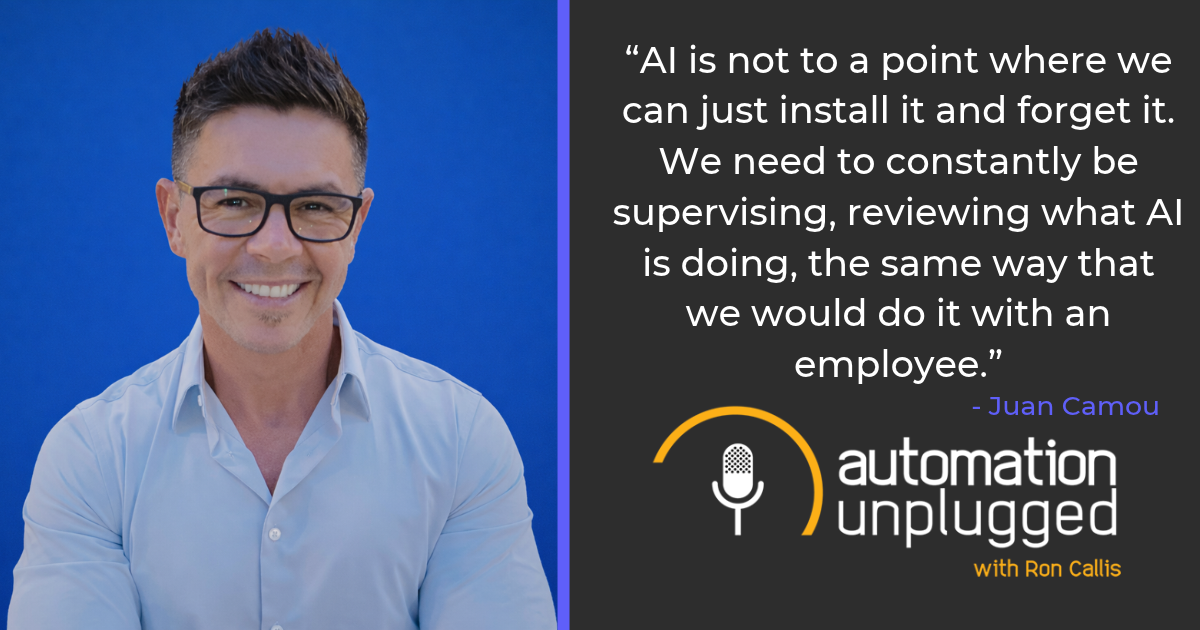
In this week's episode of AU, guest Juan Camou of Obsessed AI joins Ron to discuss why he builds a "business brain" of company data before AI ever touches the business.
This week's episode of Automation Unplugged features Juan Camou, founder of Obsessed AI, a consultancy out of Irvine, California. Juan helps integration business owners put AI to work inside their companies and buy back their own time.
Juan has been in the AV industry since 2004, and for years he co-owned a West Coast integration firm called Vision and Sound. Once he saw what AI could do to the hours an owner pours into a business, he sold his stake and went all in.
In this episode, Juan and I discussed:
- Why he builds a "business brain" of company data before AI ever touches the business
- Organizing that data by department so AI agents actually know your pricing, your ideal client, and how you build a rack
- And how to build a reusable skill and share it across your team so every scope comes out the company way
Whether you're an owner still putting in sixty hours a week or a technician wondering where AI actually fits, there's something here for you. So settle in and enjoy my conversation with Juan Camou. Let's get started!
SEE ALSO: #376: Rob Doherty on What Separates Winning Lighting Integrators
Transcript
Ron:
Hello, hello there. Ron Callis with another episode of Automation Unplugged. And today we're bringing you another special AI Insights episode. And I got a doozy for you today. This particular show and guest is with a longtime friend and AV industry veteran, but we're going to come at this from a different angle, in that this gentleman has spent decades in the seat, your seat. He was a business owner, an operator of a high-performance agency out of the West Coast, and has made a life and career change into AI consultancy. And we're actually going to talk a little bit about how, I guess I found out, maybe I had a little something to do with that. And that was kind of neat and surprising for me to hear that. But we're then going to dive into some very neat, teachable moments where I think there's going to be value for all of you out there. So today I'm happy to get you introduced to Juan Camou. He is the AI architect and his consultancy is called Obsessed AI, and he's out of Irvine, California. And let's go ahead and bring in Juan and let's see how he's doing. Hello, my friend. How are you today?
Galo:
Very good. Very excited to be here. So thank you for having me here.
Ron:
Oh man, my pleasure. In fact, I just saw you in person, like in full 3D, just a couple of weeks ago out at CEDIA in Denver.
Galo:
Yeah. You had a great space there this time. Congrats on that one.
Ron:
No, I appreciate that. I appreciate that. Well, just so that everyone gets a basic understanding of the landscape, tell us a little bit about Obsessed AI, just at a high level. What is the business? What is your consultancy? And then we'll ultimately backtrack a little bit into some of your career, just so that the audience understands where you come from.
Galo:
Okay, yeah. So the idea of Obsessed AI is to bring the AI implementation, the AI culture, into the AV industry business owners. I think there is a big gap. I see it firsthand that as owners, we need to be there fifty, sixty, seventy hours a week. And I think AI is the godsend tool that we can all use to start recovering that time and bring it back to the business, or my preference, to the family.
Ron:
I love that. Is your vision one that you're working with integration firms and that you then become a permanent fixture in their life, or that you collaborate on projects and help get them up to speed and then they become self-sufficient? What's your approach?
Galo:
Yeah, the latter. I want to bring the AI culture to every company. I mean, AI needs to have a human operator. AI is not to a point where we can just install it and forget it. We need to constantly be supervising, reviewing what AI is doing, the same way that we would do it with an employee, right? Or human. So I want to bring the culture of AI into your business, educate your lead technicians into what they can do with AI, and then I can help your firm to implement AI as the framework. And then you can maintain it, because your employees are going to be knowing the AI. So you just need to be able to talk back to the AI that I already set up for you. And because it's all plain English, it's just easy to maintain.
Ron:
Okay. I'm going to share your website, and I'd love, if your game here, let me see if I can get technology to behave here. It's always fun making that happen here. So here I'm going to do that. There we go. All right, so this is your website. And maybe take us through your approach, because you're actually offering agents and you're building out agents. And I don't want to put any words in your mouth or misstate it. So what is your approach when you're working with AV firms?
Galo:
So the idea is, sorry, we need to understand that in this AI era, the commodity is going to be data. The more data we have, the better AI is going to work for us, okay? So my approach is come to your business even before trying to implement AI, is to put a business brain together. And that's basically all the information that we need, organized by department. I like to separate it on the basic five operation departments in the company, like sales, marketing, tech support, finances. And then is create the structure where we have all the information about your company, your products, who's your ideal client, your prices, how do you like to design your rack systems, how do you like to create your proposals. So that goes before AI touches your business, right? So that would be phase one. Okay, once that we have the structure, then we can start talking about bringing agents to the business, because the AI agents is the trendy word right now. But the agents need to communicate with your business brain to understand who you are, who your ideal client is, what are we doing here, right? It's just no difference from bringing a new hire into your business, a human employee. We need to give him very detailed information on what is it that he's going to do and who we are, how we like things done, what are our secret sauces, that I call, when we're designing a rack system. So it's always very competitive between AV business owners. I think, like, we all have secret sauces, how we like to do the racks, right? If we want to put the UPS at the bottom or the network systems at the top, all of those secrets, we need to provide it to our AI agent in the same way, so he can go and design a system for you or create a proposal for you. So that's the approach. Data first, AI second.
Ron:
Got it. I understand. And as you click through your website, and this is shared on your side. Okay, I see that. Just take us through that. What are we seeing on here?
Galo:
Well, the idea is, obsessedAI.co. Yeah. So we have, the idea here is to show you how you can implement AI in your business by recovering the time that you're taking in to do something. Let's think about a repetitive task. You have an employee sending follow-up emails to a proposal, right? So you send a proposal, then you're going to have to send a follow-up email if the client doesn't get back to you in a week. How much is that costing you as a company? How much time are you paying an employee, or how much time are you spending in this task? Because that's when we start seeing the value of AI helping us in any way. So for that, sorry, I'm going to jump off towards the bottom of the page. So here's what, I put a calculator. This is trying to help business owners understand how valuable is something that you're doing. The first thing that we need to identify is if it's a task that I'm doing as a business owner, okay, how much is my per hour? I mean, if I do something instead of my assistant, is it costing me five hundred dollars an hour or two hundred dollars an hour, right? So with that mindset, we want to select who is going to be doing the task that we want to compare. In this case, a business owner. So I need to say, what is the revenue of the company per year? How many hours a week we put into the company?
Ron:
For our audio listeners, there's a calculator on the Obsessed AI website that Juan is pointing at. And he's speaking to the different fields on this calculator.
Galo:
Thank you, Ron. I forgot about that. Yes. So let's say we have a five million per year revenue in our business. And I'm working fifty-five hours a week.
Ron:
Mm hmm.
Galo:
So this is going to tell us how much is our effective per hour, right? As a business owner. Okay, so same thing applies for a technician. If I'm going to have a technician doing a task, I select the technician topic here. And then I'm going to say how much my technician is doing per year. So let's say a hundred K, and he's working forty hours a week.
Ron:
Hmm.
Galo:
So we have, that is costing me forty-eight dollars per hour.
Ron:
Forty-eight dollars per hour, right? For this technician.
Galo:
So now the next step for me is, okay, that's costing you this much per hour, but if we do it with AI, instead of this technician taking five hours to do this task, it's just going to take us one hour. So that's what we started making, or doing the math. Five hours at forty-eight, you know what I mean?
Ron:
So you're looking at, based on the personnel in the company, if there's repetitive tasks that could be offloaded to AI, how much time or cost could you potentially recoup and have AI support the business by doing those repetitive administrative tasks to free up that human to do the higher level tasks they're better suited for?
Galo:
Correct, because I think people are getting wrong, thinking that AI is, okay, something cool, it's a new technology, but what is it actually doing for me, right? So that's what I want business owners to start thinking about. How much time is going to save me if I bring AI? Because the cost of AI is way less than bringing another employee in the company. I'm not asking anybody to get rid of existing employees. That's not my goal here. But you can suit one employee that is costing you better, so we can use and free his time with AI assistance. So that's the goal for this calculator.
Ron:
I love that. I think that's a really neat reason for people to go check out obsessedai.co, just for that reason, to find that calculator. In terms of your journey, if we pull that off just for a moment here, I'm going to pull that off screen. Help me understand, what was your personal journey with AI? Like, how long have you been thinking about this? Because you were an integrator for lots of years and running your business, and you had a business partner.
Galo:
Correct.
Ron:
All the ups and downs of life that is an entrepreneurship, right?
Galo:
Yeah. So you have something to do with all of this, by the way, because I saw you at one of the conferences talking about AI for the first time. And that really got my attention. So I've been in the industry since two thousand and four, and I had a business in the West Coast, like you mentioned, with a business partner. And I always saw my business partner putting this extra, a lot of hours per week, working sixty, seventy hours a week, right? When we started the company back then, we obviously were at the same page, we need to put as many hours as possible launching the business. But then ten years later, fifteen years later, is still trying to put those hours. Stop being something that I want to keep going. I wanted to give time to my family. So I was always looking for what would be the one system or the one tool or technology that is going to help me be working less hours, but without sacrificing the business, and still having good income, or the revenue of the business would not be affected. So we tried multiple things, and nothing got my attention like AI. And when I start understanding the ROI on the time, that's when I went like, holy, this is...
Ron:
Light bulb went off over your head. You're like, yeah, this is what I've been waiting for, right?
Galo:
Yeah. I went all in. I just became obsessed. That's where the name of the company came with. It was like an instant falling in love with the technology. And next thing I know, I'm calling my business partner and saying, you know what? You want to buy my part? I'm going full on on AI. I think there is a huge opportunity to help many business owners go back to their families. That's the close to my heart that made me change and throw, not throw everything, because I mean, I had a great time at Vision and Sound, but I saw the opportunity I can help other people while doing something that I enjoy, which is technology.
Ron:
I love that. I appreciate you sharing that journey. Let's jump right into a teachable moment for our audience. And that's going to be around, you and I did chat in advance, so I'm going to help guide the audience here through what you're about to show us. And that is, you're going to go into Claude and you're going to talk about a scenario, or demonstrate a scenario from Vision and Sound, from your past career, where you could be out on a job site and you recorded a client meeting. And you're then activating a skill inside of Claude that could either be inside of chat or Cowork. And you're then outputting some valuable information. So maybe let's start there. What type of meeting would be, air quote, recorded? And what is the skill going to create for you or your team back in the office?
Galo:
So if you allow me, we need to start with, need to be one of the mindsets that we need to adopt with AI is becoming AI architects. We need to start finding what are the bottlenecks in the business. And somebody, some people is not going to like this, but most of the time the bottleneck are us as business owners, right? So just imagine this pain. The pain is you go to a meeting, the initial meeting with a client, you're taking notes. And the client is telling you what he wants on every room in the house. The wife is also speaking to you, and you're trying to keep up with the notes. For me, it was an hour, hour and a half walkthrough with a family. Then the second step was go to my office, take all of these notes and pictures and put them together. English is not my first language, as you can tell. So putting an email together, it was really time consuming for me, okay? Not just putting all the notes together, organized, but also type the email, right? So how can AI help me with that? That simple pain problem. So if we take the iPhone and we record using the Voice Memos app in it, and instead of taking notes manually or typing them, we just let it run. We are very detailed when we're speaking. We're asking all the questions. And if we don't understand something that client said, we repeat it, right? So we go room by room. And that's going to give us all the details that we need. That's the initial walkthrough with a client. So now we have data, that I was saying data is king right now. So the next step is for me to take that data and give it to AI and do what was causing pain to me, which was putting the scope of work and the email together. So if we do it this way, you have the transcript in your phone. Imagine walking out of the house into your car, copy the transcript and give it to your AI as you walk into your car and hit send, and that can do two things for you. It's going to create a scope of work that you can then send to your system designer at your office, from the car. And two, you can send an email to the client that you just walked from the house two minutes ago and say, thank you so much, Mr. Johnson, for meeting me today. Here's what we discussed. I will have something for you next week. And you just send them a summary within minutes, right? So for me, that's a wow experience to the client, and it's saving me twenty, thirty, forty, or an hour of my time just from putting something nice together. So this is what I want to show you.
Ron:
Let's do it. I'm going to share your screen. Okay, here we go. I'm going to put it up on the screen here. All right, we see this looks like we're in Claude.
Galo:
Correct.
Ron:
We're on Claude, the chat side of this.
Galo:
This is not Cowork, or, sorry, this is Cowork, it's not Code. It's very important to make the difference. A skill, Ron, for those in your audience that are wondering what a skill is, a skill is just a set of instructions in a very structured way that we want to give to AI. So if we save the set of instructions into a skill, we can just use it again and again and again. It's going to give us the same result, versus asking AI something that is not organized or with lack of structure. That's going to give us a different result every time.
Ron:
Another legacy format that some folks listening may have heard, I say legacy, you know, from the old days, like a year or two ago, was that you heard the concept of a prompt library. Maybe there's a prompt that worked really well in this case, maybe to write an email or to write a scope of work. And we would talk about saving a prompt library in Claude. Now you can create that prompt into a piece of architecture called a skill. And you give that skill a name. And then every time you call that name up, it runs that set of instructions.
Galo:
You're right. Yes.
Ron:
All right. Are you able to demonstrate your skill here, or this concept?
Galo:
Correct. So first thing that we need to do is, once we're inside the chat box, is call the skill. In this case, I call it Walk to Scope. That's the name of the skill. And it's going to tell me, it tells me here what is exactly it's going to do, but basically it's going to take the meeting notes, the audio file transcribed into a text file. Then the second thing I need to do is bring that one here.
Ron:
Right. Okay. You just dropped a text file into the chat window.
Galo:
Correct. And I got these from my Voice Memos app on my iPhone. I finished recording, copy the transcript and convert it into a file. And this is what I'm bringing here to the skill.
Ron:
Okay.
Galo:
And that's it. I don't have to say anything else, because all the details are saving to the skill already.
Ron:
So before you press send on the window here, I see that, yes, you're in Cowork. And I guess we could argue you could be in chat or Cowork to run this.
Galo:
Totally.
Ron:
But then I see the model. Do you have an opinion on what model you run? Like right on my screen, I see it's Sonnet 5.
Galo:
Correct.
Ron:
Do you have an opinion, or maybe just educate the audience? How should they think about which model to run an action against?
Galo:
Okay, that's a great point. The harder the task, the better model you want. With AI, the models have different costs. So the smarter the model, the more money is going to cost you. So that's going to be something that you're going to have to learn as you go, and see if you're liking the results with a cheaper model, you can keep using it. But if you're going to ask them to do a system design or a full proposal, you might want to jump into something more efficient. In this case, can be Fable. Let's see, where is my Fable? More models, yeah.
Ron:
You're trying to spend some tokens.
Galo:
Yeah, let's just do it for the audience. Okay, so like I said, all we need is my skill and the text file. That's it. No more details given. And we hit enter, and that's going to, the AI now is working, it's processing the information, right? I don't want to keep your audience waiting, so I went ahead and did this already earlier, and this is the result. It basically took all the garbage, all unorganized notes, and put it nice into room by room, right? It's giving us all the details, what is it that I discussed with the client. So what we talk about, where we went, at the entry room, the great room, lounge, all the rooms. And then it's talking about cameras, alarm system, lighting. It's organizing everything by system. But this is the cool part. This skill is telling the AI to organize it like this. But if you want to organize in a different way, it's just a matter of going to the skill and change it, right? We can adopt the same skill and ask it to do it in a different way.
Ron:
So for folks listening, like if they wanted to standardize this mechanism, say across all of their salespeople or all of their PMs that are doing walkthroughs with clients, and they're either recording the conversation or recording notes transcribed into the, in your case, you talked about the recorder on your iPhone, that you now could standardize in a company way the way that a scope is documented. So even though you have maybe four different people doing those meetings, you could have the company way of communicating scopes, whether externally to your customer or internally to your team.
Galo:
Absolutely.
Ron:
And that's a way to remove friction, right? Or remove errors.
Galo:
Absolutely. And something that we need to get into the habit of doing is, every time that we get the good result from AI, we need to let them know, like, hey, I like what you did here. Save it to the memory, or adjust the skill that we just did to make sure that we get this result every time. And again, you just talk plain English back to your AI. There is no need to learn any coding or anything like that.
Ron:
I love that. I'm looking at the clock here, and could we take a moment, unless you have more on this one, can we take a moment or two and just have you teach our audience just a little bit about the basics of creating a skill?
Galo:
Correct. Before we jump into that, I just want to say, you got this text document here, but the next step from the skill, once we get the result that we want, one, it might ask me a question, like it's doing at the bottom. It's asking me to confirm something that it couldn't get quite right. The second thing is you just ask it to create a PDF, or you can even go to the extent of asking to create a web app, okay? Whatever output you want to send to your human system designer. Now let's talk about how to create a skill. So the very first step to create the skill is you want to talk to AI, telling the outcome. So in this case, I will say something like, hey, my pain is this, I'm taking notes manually every time that I meet with a client, I would like to record this by voice, and then I want you to organize all the notes so I can give it to my system designer. You can start with something as simple as that. Then you run a test, you bring the recording, you paste it, and if you like the outcome, then you ask, hey, please save this as a skill. And it's going to give you the file that is going to be downloaded to your computer, right? And that's the basis of how you create the skill. Very simple. To install it in your system, you got to go to the settings, to the left side. Sorry, with Claude, you're going to go to the left menu and find Customize. And then we have the skills button right here. And this is where you just going to click and upload the skill that you just created.
Ron:
So if you wanted to share a skill you created with other people on your staff, you would literally give them the file and then they would upload that file into their environment.
Galo:
Absolutely. Yeah. So this skill that I used to create a walkthrough, it can be shared with anybody. They just send it via email and they just bring it to the upload skill and drag it there.
Ron:
I love that. Juan, I appreciate that. That was really, you made that really easy to understand and super approachable information. For folks that want to get in touch with you and either just meet you, talk to you about AI, or potentially talk to you about how you guys might work together, where would you want to send people?
Galo:
So on the website, we have a calendar link. That would be the easiest way. There's no commitment of any way. So you can just book a call, thirty minutes or one hour. We have two options in there. If you want to text me, you can go to our social media, which at the bottom of my website, you're going to find that as well.
Ron:
And for our audio listeners, that's on Instagram. You're at G-A-L-O-C-A-M-O-U.
Galo:
Correct. Galo Camou.
Ron:
Galo Camou.
Galo:
Same thing for LinkedIn.
Ron:
Same thing for LinkedIn. Okay. And what about email?
Galo:
Email will be
Ron:
Okay. Awesome. Juan, I am excited for your new venture. I'm excited that you're excited about AI. I agree. This is changing everything about everything. And I appreciate that you are fully committed. You've burned the boats, as they say. You're all in on this new world.
Galo:
I'm all in. There's no way back.
Ron:
There's no way back. And you're out there to help people, which is, I think, really cool. So thank you for sharing your wisdom here on this AI Insights episode of Automation Unplugged. It was a pleasure having you on the show.
Galo:
Thank you, Ron.
Ron:
Until next time.
Galo:
Until next time.
Ron Callis is the CEO of One Firefly, LLC, a digital marketing agency based out of South Florida and creator of Automation Unplugged. Founded in 2007, One Firefly has quickly became the leading marketing firm specializing in the integrated technology and security space. The One Firefly team work hard to create innovative solutions to help Integrators boost their online presence, such as the elite website solution, Mercury Pro.
Resources and links from the interview:
Show Notes:
Links:
https://www.linkedin.com/in/galocamou/
https://www.instagram.com/galocamou/